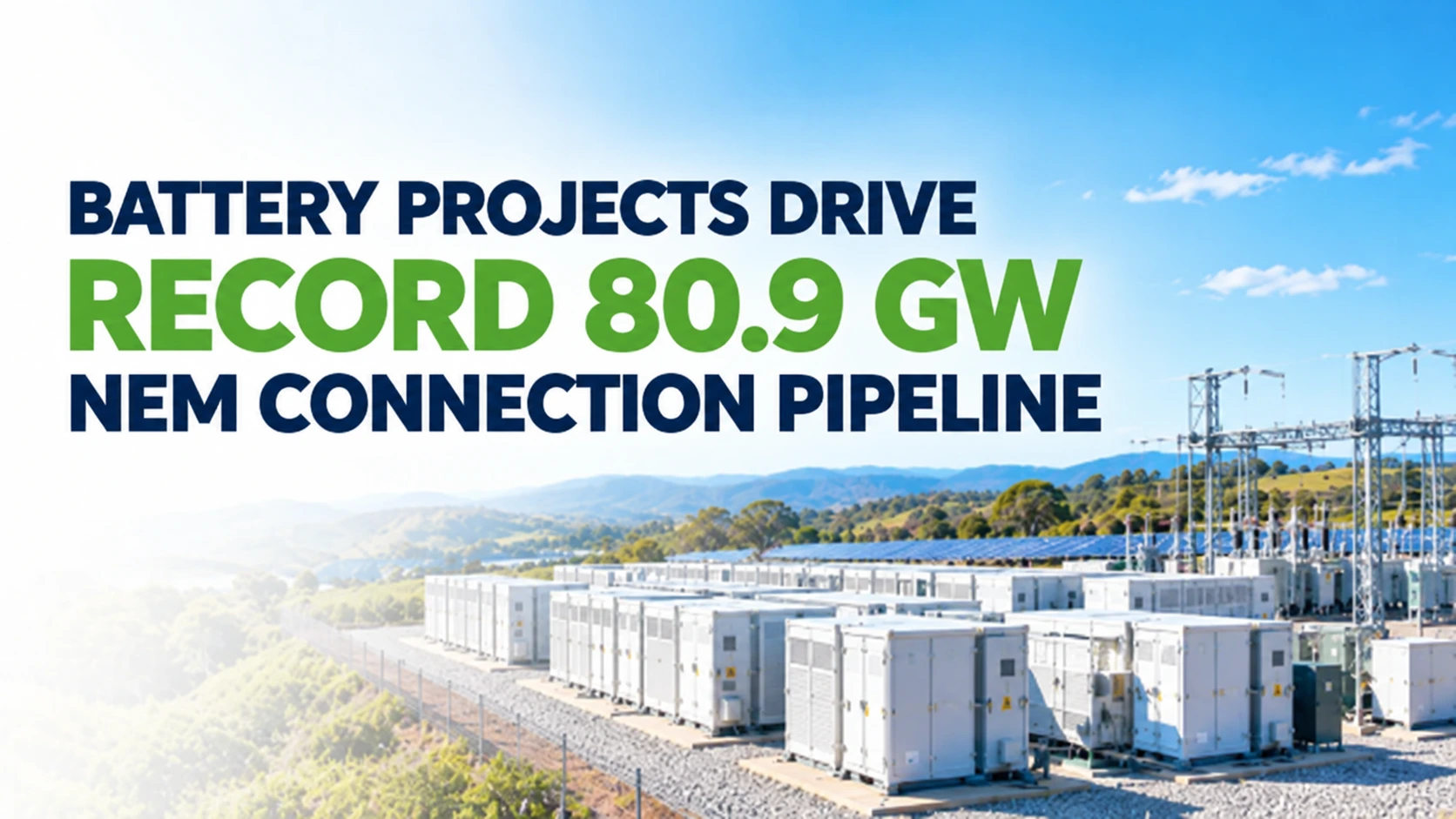
Australia’s pipeline of new electricity generation and storage projects seeking connection to the National Electricity Market (NEM) has grown 43% in a year to reach 80.9 gigawatts (GW), surpassing the market’s existing capacity of 77 GW for the first time.
The Australian Energy Market Operator (AEMO) reported the increase in its September 2026 Connections Scorecard, released on 21 October. Grid-scale batteries account for 55% of the capacity progressing through the connection process, reflecting growing interest in storing electricity and supplying it when demand rises.
However, the record pipeline does not mean Australia has added 80.9 GW of new electricity supply. Most projects remain in the early stages of development, and their contribution to electricity supply will depend on whether they progress through approvals, registration and commissioning.
Our other latest news you may find interesting: Snowy 2.0 Cost Estimate Hits $22.2 Billion as Completion Slips to 2029
Batteries Dominate Australia’s New Energy Project Pipeline
Battery projects account for more than half of the capacity progressing through the NEM connection process, according to AEMO. Hybrid solar and battery projects represent another 19%, followed by wind at 15%, solar at 5%, hydro at 5% and gas at 1%.
Batteries now account for the largest share of proposed capacity in the connection pipeline. They can store electricity when supply is plentiful and release it during periods of higher demand, including the evening peak when rooftop solar generation declines.
AEMO Group Manager of Onboarding and Connections James Lindley said the pipeline had surpassed the market’s existing capacity for the first time.
“A strong pipeline is encouraging, but what ultimately matters for consumers is getting viable projects connected and operating in the power system,” Mr Lindley said.
The distinction matters because planned capacity only benefits electricity consumers once projects become operational. Delays in construction, financing, commercial agreements and technical approvals can affect when new generation and storage become available.
New Battery Applications Account for 76% of Proposed Capacity
Battery developers also dominated new connection applications during the September quarter.
AEMO received 25 new applications representing 7.5 GW of proposed generation and storage capacity. Nineteen battery projects accounted for 5.8 GW, equivalent to 76% of the new capacity seeking connection.
During the same quarter, 23 projects totalling 4.5 GW received application approval. Four projects representing 1 GW were registered and connected to the NEM, while seven projects totalling 1.3 GW completed commissioning and reached full output.
These figures track projects at different stages of the NEM connection process. Application approval and registration are milestones on the way to operation, while commissioning tests whether a project can operate as intended and progress towards full output.
The figures therefore provide a more useful picture of the market than the headline pipeline alone. While developers continue proposing large amounts of new capacity, the number of projects reaching operation determines how quickly that investment can strengthen electricity supply.
Enjoying our news? You may also read: European Energy Signs 30-Year Agreements for Three Queensland Solar and Battery Projects
Longer Duration Batteries Could Support Renewable Supply
AEMO also reported growing interest in longer-duration battery storage. Nearly 40% of battery projects in the pipeline can provide between three and 10 hours of storage, according to Mr Lindley.
Longer-duration storage can help address periods when solar and wind generation fall short of demand. A battery can charge when electricity is available and discharge later, reducing the need to rely on other generators during periods of tighter supply.
However, storage duration alone does not determine a project’s value to the grid. Its capacity, charging opportunities, location, connection infrastructure and operating arrangements also influence how effectively it can support electricity supply.
The growing share of longer-duration projects suggests developers are considering a wider range of storage needs as renewable generation expands.
Most Proposed Capacity Remains in Early Development
Despite the record pipeline, 88% of the capacity remains in the early application and proponent implementation stages, according to AEMO.
Capacity at the application stage increased 101% over the year to 38.5 GW, while capacity in proponent implementation rose 42% to 32.3 GW. Proponent implementation is a developer-led stage in the connection process.
Projects can encounter delays when developers change ownership or designs, revise equipment selections or take longer to finalise financing and commercial arrangements. These issues can prevent proposed capacity from reaching operation on its original schedule.
The scale of the pipeline is particularly relevant because AEMO expects around 15 GW of generation to retire over the coming decade, while electricity consumption is forecast to increase by more than 40%.
Maintaining reliable supply will therefore depend on more than attracting investment. Australia must also connect viable projects and bring sufficient new generation and storage online as older facilities retire and electricity demand grows.
AEMO and industry are progressing the second phase of the Connections Reform Initiative and other measures designed to streamline registration, strengthen technical frameworks and improve the transparency and predictability of connection outcomes.
You may also want to read: Australian Wholesale Electricity Prices Fall 27% as Solar Grows
CleanSwitch Takeaway: What We Think
AEMO’s latest Connections Scorecard shows that Australia’s proposed generation and storage pipeline has reached 80.9 GW, exceeding the NEM’s existing 77 GW capacity for the first time. Batteries account for 55% of the pipeline, while new battery applications represented 76% of proposed capacity submitted during the September quarter.
The key challenge is turning those proposals into operating infrastructure. With older generators scheduled to retire and electricity consumption forecast to rise, timely project approvals, grid connections and commissioning will play an important role in maintaining reliable electricity supply as Australia’s energy mix changes.
At CleanSwitch we will continue tracking developments in battery storage, renewable generation and electricity infrastructure and explain what these changes could mean for Australia’s energy system and household electricity costs. Keep an eye!