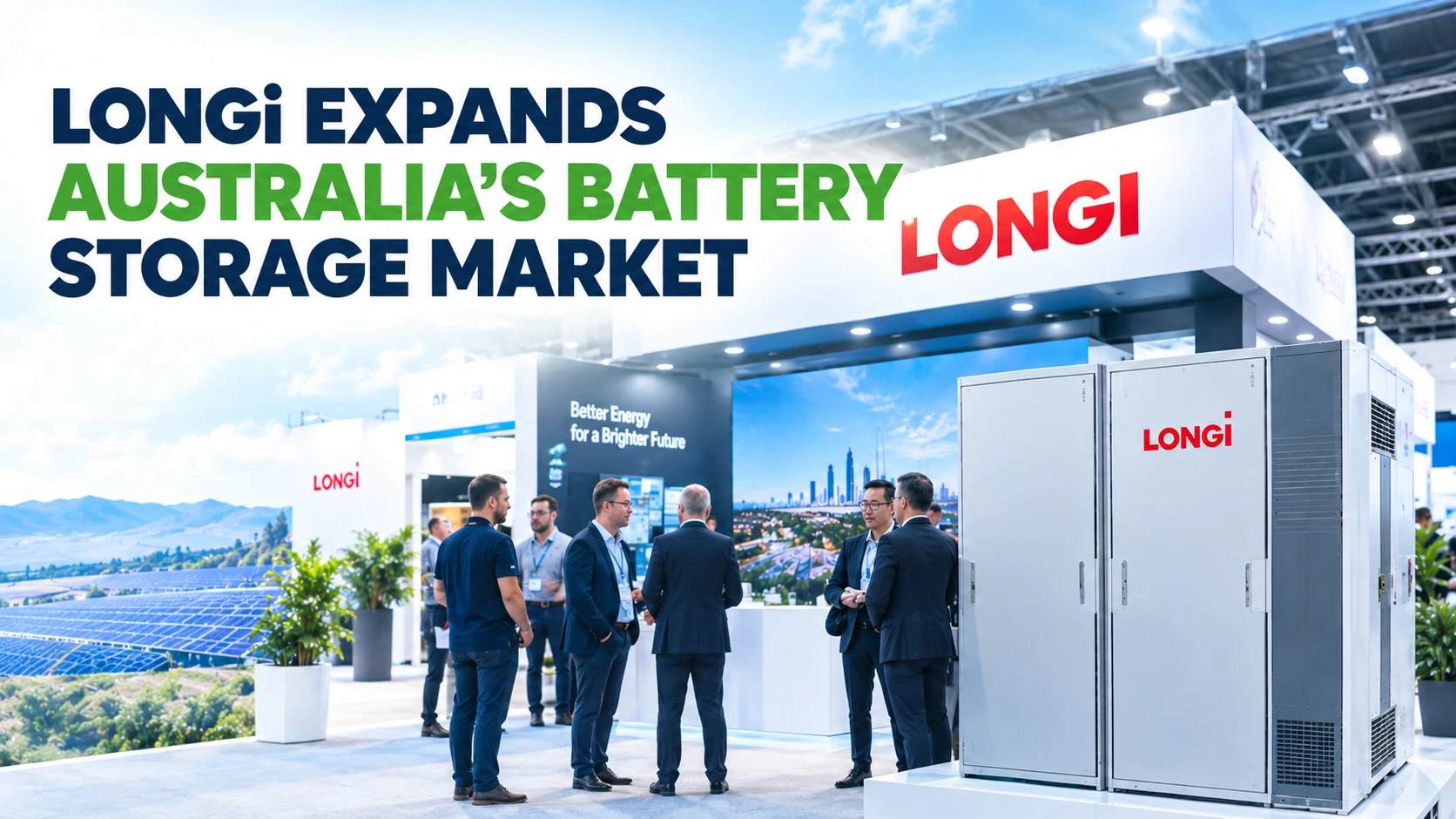
Australia’s renewable energy expansion is creating opportunities for a different kind of energy investment. As more wind and solar projects connect to the electricity grid, the ability to store electricity and deliver it when needed is becoming increasingly important.
That was the focus of LONGi Energy Storage’s appearance at All-Energy Australia 2026 in Melbourne, where the company presented battery solutions for electricity networks, commercial businesses and remote operations.
In an announcement published on 30 October, LONGi outlined three major areas of its storage business, including its OneMatrix utility-scale platform, Hi-MO One Pro commercial storage system and OneNexus microgrid solutions.
The announcement also highlighted a 5 MW / 20 MWh battery installation at Strathalbyn in South Australia, providing a local example of how battery storage is already participating in Australia’s electricity market.
The developments point to a growing shift in Australia’s energy industry. Building more renewable generation is only part of the challenge. The electricity produced also needs to be stored, managed and delivered when demand rises.
You may also want to read: What Are The Best Home Energy Saver Loan Upgrades To Make?
NSW Home Energy Saver Loan for Solar and Battery Systems
A Four-Hour Battery Is Already Trading in South Australia’s Electricity Market
One of the most interesting parts of LONGi’s announcement is the Strathalbyn Battery Energy Storage System (BESS), which uses four LONGiBank 2.0 systems with a combined capacity of 5 MW and 20 MWh.
Located in South Australia’s Alexandrina Council area, the installation is designed to store electricity and return it to the grid in response to market conditions.
Its 20 MWh storage capacity gives it four hours of discharge at its rated 5 MW output, assuming the battery is fully charged and operating within its technical limits.
That matters because electricity demand and renewable generation do not always occur at the same time. Solar farms can produce substantial amounts of electricity during daylight hours, while demand can remain high after sunset. Batteries provide a way to move some of that electricity into periods when it is needed.
The project is owned and operated by Lunio Energy, which announced on 20 July 2026 that the Strathalbyn battery had connected to the grid and started trading in the National Electricity Market (NEM).
According to Lunio Energy’s project announcement, the battery stores electricity when supply is abundant and prices are low, then returns it to the grid when electricity is needed.
The project also uses OptiGrid’s OptiBidder platform to forecast electricity prices and optimise charging, discharging and market bidding.
This is particularly relevant in South Australia, where high levels of wind and solar generation can contribute to significant changes in wholesale electricity prices.
The battery therefore has two roles: storing electricity for later use and responding to opportunities in the electricity market.
LONGi’s OneMatrix Targets Australia’s Large-Scale Battery Projects
Beyond Strathalbyn, LONGi used All-Energy Australia to present its OneMatrix Solution for utility-scale energy storage.
The platform is designed for large renewable energy projects, standalone grid batteries and electricity market operations.
At its centre is LONGiBank 3.0, which supports storage configurations ranging from two to eight hours. This gives project developers flexibility to design battery installations around their intended applications and operating requirements.
LONGi also highlighted several features intended to support battery management, including independent control of battery clusters, AI-powered battery health diagnostics and intelligent operations and maintenance.
These systems are designed to help operators monitor battery conditions, identify potential performance issues and manage storage assets throughout their operating lives.
The company also reported that OneMatrix had received TÜV Rheinland certifications under IEC 62619 and IEC 63056, together with an IEC/EN 60730-1 Annex H report.
These standards and assessments relate to battery safety and control requirements. However, certification alone does not guarantee the performance or financial returns of an individual storage project.
The more important question for Australia’s electricity industry is how effectively these systems can be integrated into the grid and operated as renewable generation continues to expand.
Businesses Could Use Battery Storage to Manage Electricity Costs
LONGi’s second major offering targets commercial and industrial customers.
Its Hi-MO One Pro solution supports configurations ranging from two to 24 hours and is designed for businesses combining solar generation with battery storage.
The system is intended to support several applications, including solar-plus-storage installations, electricity cost management, and backup power.
For businesses with large electricity bills, battery storage can provide an opportunity to store excess solar generation and use it later rather than relying entirely on grid electricity.
It can also help businesses manage their consumption during expensive electricity periods, depending on their retail arrangements and operating patterns.
LONGi says Hi-MO One Pro uses its proprietary iCCS technology and liquid-cooling system. The company also describes the platform as supporting both grid-connected and off-grid operation.
However, longer storage duration does not automatically translate into greater savings. Businesses still need to consider battery purchase costs, electricity tariffs, charging opportunities, operating efficiency, and the expected lifetime of the system.
The economics will differ considerably between a manufacturing facility, a warehouse and a business with substantial daytime electricity consumption.
Our other news you may find interesting: Midea Launches Edith Series Air Conditioners in Australia With AI Energy-Saving Technology
Microgrids Could Reduce Diesel Dependence in Remote Operations
Another part of LONGi’s announcement focused on remote areas and mining operations, where access to reliable grid electricity can be limited.
The company presented its OneNexus H2 and M5 solutions, which coordinate solar generation, battery storage and diesel generators.
This combination is particularly relevant to remote operations that rely heavily on diesel for electricity.
Solar can supply power when sunlight is available, while batteries store surplus generation for later use. Diesel generators remain available when renewable generation and stored electricity cannot meet demand.
The aim is to increase renewable energy use without compromising the reliability required by mining operations and other remote facilities.
Reducing diesel consumption could also lower fuel transportation requirements and exposure to fluctuating fuel prices.
However, the actual savings will depend on the site’s electricity demand, solar resource, battery capacity, diesel costs and system configuration.
LONGi has not published specific Australian project savings or diesel-reduction figures for the OneNexus H2 and M5 solutions in its announcement.
LONGi Plans to Expand Its Local Support Network
Technology was not the only focus of LONGi’s announcement.
The company also outlined plans to expand its local service capabilities through its LONGi ONE strategy, which brings together technology development, integrated energy solutions and ongoing operations and maintenance.
One part of this strategy is the 2830 Plan, under which LONGi aims to establish 30 comprehensive local service centres worldwide by the end of 2028.
For Australia’s battery storage industry, local technical support is an important consideration. Large battery installations require more than equipment supply. They also involve project design, grid integration, commissioning, monitoring and maintenance.
LONGi says its approach will cover the project lifecycle, from solution design and delivery through ongoing operations.
The company is positioning this service network as part of its longer-term commitment to the Australian market.
What LONGi’s All-Energy Announcement Tells Us About Australia’s Battery Market
The range of technologies presented by LONGi reflects how quickly the battery storage industry is expanding beyond residential applications.
Grid-scale batteries are being developed to support electricity networks and renewable energy projects. Commercial storage systems are targeting businesses with substantial electricity requirements, while microgrids offer another option for remote operations.
These are different markets, but they share one requirement: making electricity available when and where it is needed.
The Strathalbyn project offers a practical example of how storage can participate in the NEM, responding to electricity prices and market requirements rather than simply holding surplus solar generation.
LONGi’s latest announcement also comes as battery manufacturers compete for a larger role in Australia’s expanding storage market. Its presentation at All-Energy shows the company’s intention to serve several parts of that market rather than concentrate on one application.
However, the announcement primarily outlines the company’s technology portfolio and market strategy. It does not disclose new Australian supply contracts, investment commitments, or independently verified savings from the newly presented solutions.
Those details will be worth watching as more projects move from product demonstrations and announcements into actual deployment.
Related news you may explore: Sungrow Launches Home Battery That Can Expand to 120 kWh as Australian Energy Needs Grow
Victoria Expands Apartment Solar Rebates, Opening Access to Larger Buildings
FranklinWH Unveils Hybrid Battery System With Smarter Solar Controls
Australia Adds More Battery Storage in Six Months Than in All of 2025
CleanSwitch Take: What We Think
What caught our attention about LONGi’s announcement is how much the battery storage conversation has changed.
The industry is no longer talking about batteries only as an addition to rooftop solar systems. Companies are now targeting electricity networks, factories, mining operations and remote communities, each with different energy requirements.
The Strathalbyn installation is particularly interesting because it demonstrates how a relatively small four-hour battery can participate directly in the electricity market. It also highlights the growing importance of forecasting and intelligent battery management, not just the amount of electricity a battery can store.
We are also interested in how LONGi’s longer-duration storage offerings will compete in Australia’s commercial and utility-scale markets. Product announcements are one thing, but the real test will be project deployments, operating performance and the financial results delivered to customers.
Our team at CleanSwitch will continue following developments from All-Energy Australia and Australia’s wider battery storage industry, bringing readers updates on new projects, company announcements and technologies that could shape the country’s energy future.