Quick Answer
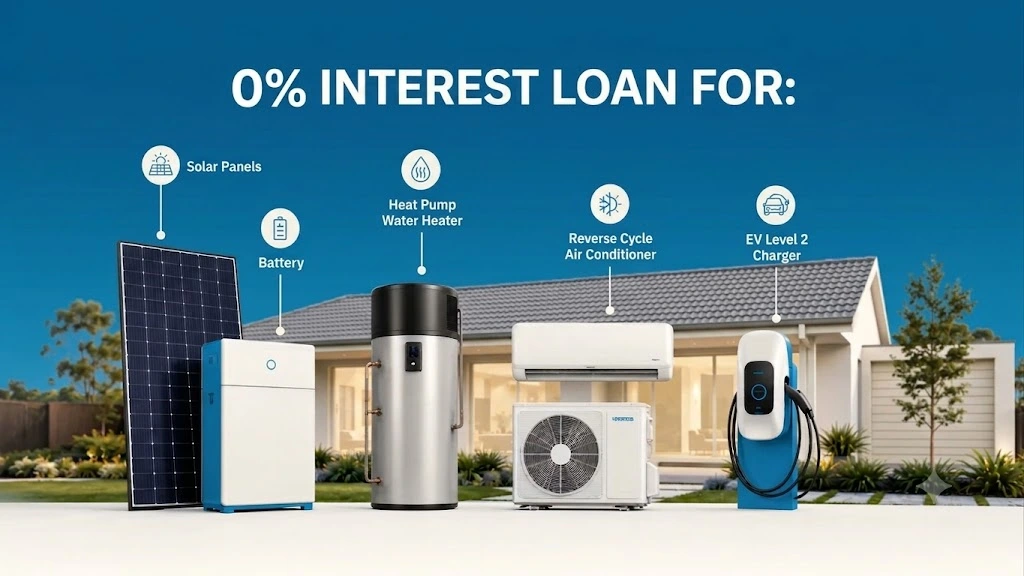
The best Home Energy Saver Loan upgrades you can achieve with the NSW Home Energy Loan are a solar panel and battery system, a heat pump water heater, a reverse cycle air conditioner, and a Level 2 EV charger. These upgrades can significantly reduce energy consumption, lower electricity bills, improve home comfort, and help future-proof your home for years to come.
Let’s find out why they are the upgrades you should always prioritise.
Quick Savings Overview
| Upgrade | How It Works | Verified NSW Data / Savings |
| Solar & Battery System | Stores daytime sun to power your home after sunset. | Saves up to $2,300+ per year on bills. |
| Heat Pump Water Heater | Sucks in free heat from the air instead of creating it. | Cuts hot water energy use by up to 75% (saves $200–$800/yr). |
| Reverse Cycle AC | Moves heat to keep you warm in winter and cool in summer. | Saves $200 to $600 per year compared to older systems. |
| Level 2 EV Charger | Charge your electric vehicle directly from your solar power. | Lowers vehicle running costs by up to 70% compared to petrol and reduces 40% on servicing costs. |
1. Solar Panels And a Home Battery
Best suited for: Homeowners with high electricity use, families at home during the day, or anyone planning to stay in their property for the long term.
A rooftop solar and battery system offers the highest-value upgrade you can make under the Home Energy Saver program because they directly tackle the highest household expense: electricity.
Solar panels generate clean power during the day to run your home for free. If they generate more power than you need, you have the option to install a solar power storage battery or sell back the excess energy to the grid. Installing the solar battery with the NSW interest-free loan means you can power your home after dark using your own free, stored energy during expensive peak-rate hours.
Interestingly, this combination can save you up to $2,300+ per year on bills. In many cases, the $2,300+ in annual power bill savings is larger than your annual loan repayments. This means the system can effectively pay for itself from day one, allowing you to wipe out your power bills using the government’s money interest-free.
Key Benefits of Solar and Storage Battery
- You can save 80% to 100% on electricity bills.
- Greater protection from rising energy prices.
- Increased use of self-generated electricity.
- Less reliance on the electricity grid.
- Long-term savings that continue for many years.
2. Reverse Cycle Air Conditioner
Best suited for: Homes with outdated climate systems, ageing air conditioners, or properties without efficient temperature control.
With heating and cooling accounting for up to 20% to 50% of all energy used in Australian homes, a modern reverse cycle AC is a priority upgrade to consider under the NSW $15,000 home energy interest-free loan.
Instead of creating heating or cooling from scratch, this system uses clever refrigeration technology to transfer existing heat between the indoors and outdoors. In winter, it absorbs heat from the outside air and pumps it indoors to warm the room. In summer, it reverses the process, pulling heat out of your house and dumping it outside to cool things down. Because it simply moves heat around, it operates at a remarkable 300% to 600% efficiency.
This means it takes just 1 unit of electrical energy and turns it into 3 to 6 times as much climate-controlled comfort. Upgrading to this dual-purpose system with the NSW interest-free loan allows you to replace separate, power-hungry heating and cooling units without a high upfront cost.
Interestingly, this year-round efficiency can save you between $200 and $600 per year compared to older, standalone appliances. Over the course of the government’s 10-year interest-free loan, those seasonal bill reductions add up to thousands of dollars in savings while keeping your living spaces perfectly comfortable in both peak summer and deep winter.
Key benefits of Reverse Cycle AC
- Replaces the need for separate heating and cooling systems.
- Highly efficient heating in winter and cooling in summer from a single unit.
- Delivers 3 to 6 times more heating or cooling energy than the electricity it consumes.
- Saves $200 to $600 per year compared to older heaters and cooling units.
- Directly lowers the biggest energy user in your home (which makes up 20% to 50% of your bill).
3. Heat Pump Hot Water System
Best suited for: Homes with older electric storage tanks or gas hot water systems looking to reduce a major fixed household cost.
After cooling and heating, traditional water heaters are the second largest household energy consumers, accounting for 15% to 30% of your total power bill.
A heat pump water heater saves on electricity use because it pulls free heat from the surrounding outdoor air instead of creating it. They have a Coefficient of Performance (COP) of 3 to 4, meaning for every 1 unit of electricity the system consumes, it delivers 3 to 4 units of heating energy to your water.
Because it relies on this free ambient air warmth rather than a heavy electrical element, it cuts your hot water energy use by up to 75% compared to standard water heaters. In monetary terms, this translates to a massive saving of $200 to $800 per year on your running costs.
Key Benefits of Heat Pump Water Heater
- Cuts hot water energy consumption by up to 75% compared to standard electric tanks.
- Lowers annual energy bills by $200 to $800, providing immediate budget relief.
- Directly tackles the second-largest energy drain in the home
- Pairs with solar panels and built-in timers to heat water during peak sun hours for maximum savings.
- Avoids roof space restrictions since the entire unit is ground-mounted at the side of the house.
4. Electric Vehicle (EV) Charger
Best suited for: Electric vehicle owners, households planning to purchase an EV soon, or daily commuters looking to minimise their transport costs.
While an electric vehicle already cuts out your petrol expenses, charging it can become a noticeable addition to your household electricity use. Installing a dedicated home EV charger under the Home Energy Saver program ensures you can fuel your car safely, quickly, and at the absolute lowest possible cost.
A standard wall outlet takes a long time to charge a car and draws power indiscriminately. A smart home EV charger allows you to control exactly when and how your vehicle takes power. By setting the charger to activate during off-peak midnight hours when grid rates drop, or syncing it directly to your solar panels during the day, you ensure your car runs on ultra-cheap or entirely free energy.
In monetary terms, this translates to saving up to $1,000+ per year compared to standard charging or public stations. Financing the installation through the NSW interest-free loan removes the upfront setup barrier, letting you lock in virtually free transport costs right away.
Key benefits of Level 2 EV Chargers
- Charges your vehicle up to 3 to 4 times faster than a standard household wall plug.
- Saves up to $1,000+ annually by scheduling charges during the cheapest off-peak hours.
- Integrates with solar systems to fill your car’s battery using 100% free, self-generated power.
- Reduces wear on your car’s battery system through smart, stable power delivery.
- Future-proofs your home as Australia transitions toward electric transport.
Which Upgrade Delivers the Greatest Value Under the Home Energy Saver Loan?
Each upgrade addresses a different part of your home’s energy use, but they work even better together.
- Solar panels and a battery help reduce your reliance on grid electricity.
- A heat pump water heater cuts one of the largest household energy expenses.
- A reverse cycle air conditioner provides efficient year-round comfort.
- A Level 2 EV charger prepares your home for cleaner, more affordable transport.
By using the NSW Home Energy Loan to finance these improvements, homeowners can spread the upfront cost while enjoying lower energy bills, improved comfort, and a more energy-efficient home for years to come.
Final Thoughts
The best Home Energy Saver Loan upgrades are those that deliver meaningful energy savings while improving the way your home performs every day. As we’ve explored, installing solar panels with a battery can reduce your reliance on grid electricity, a heat pump water heater can lower one of your home’s biggest energy expenses, a reverse cycle air conditioner provides efficient heating and cooling, and a Level 2 EV charger prepares your home for the growing shift to electric vehicles.
Choosing the right Home Energy Saver Loan upgrade depends on your household’s energy needs and future plans, but each of these improvements offers lasting value. The NSW Home Energy Loan makes these energy-efficient upgrades more accessible by spreading the upfront cost, allowing eligible homeowners to enjoy lower running costs, greater comfort, and a home that’s better prepared for the future.
FAQs About NSW Home Energy Saver Program Best Upgrades
Can I bundle multiple upgrades into a single loan?
Yes. You can use the loan to fund more than one approved technology at the same time. For example, you can combine a heat pump water heater upgrade with a reverse cycle air conditioner installation under a single application, provided the total finance amount does not exceed the $15,000 program limit.
What happens if my chosen upgrades cost more than $15,000?
The maximum amount you can borrow through the program is $15,000. If your total installation cost is higher than this cap, you are responsible for paying the remaining balance directly to your approved supplier according to your contract terms.
Are there any hidden fees or account-keeping costs with these loans?
The Home Energy Saver loan features 0% interest and carries no upfront establishment fees or ongoing monthly account-keeping fees. However, the approved finance providers (Brighte and Plenti) may apply standard late payment fees if your scheduled repayments are missed.
Who is eligible for these upgrades under the zero-interest loan?
To qualify for the interest-free loan, you must be an Australian citizen or permanent resident who owns the property in New South Wales (either as an owner-occupier or a landlord). Your household’s combined annual taxable income must be $210,000 or less, and you must meet the credit criteria of the program’s finance providers.
Can I combine the loan with other solar or energy rebates?
Yes. The interest-free loan can be used alongside existing government incentives, such as federal Small-scale Technology Certificates (STCs) for solar and heat pumps, or the NSW Energy Savings Scheme. These incentives are applied to reduce the total cost of your quote before the loan amount is finalised.
Can landlords or renters access this program?
Landlords who own a residential property in NSW are eligible to apply for the zero-interest loan to upgrade their rental properties. While renters cannot apply for the loan itself, the upcoming $4,000 cash discount component of the program will be accessible to eligible lower-income tenants who have written permission from their landlord.
How do I apply for the loan and get the upgrades installed?
You cannot apply for the finance directly on your own. You must first get a quote from a program-approved, accredited installer. Once you accept the quote, the installer will send you a secure application link through one of the approved finance providers to complete your assessment online.