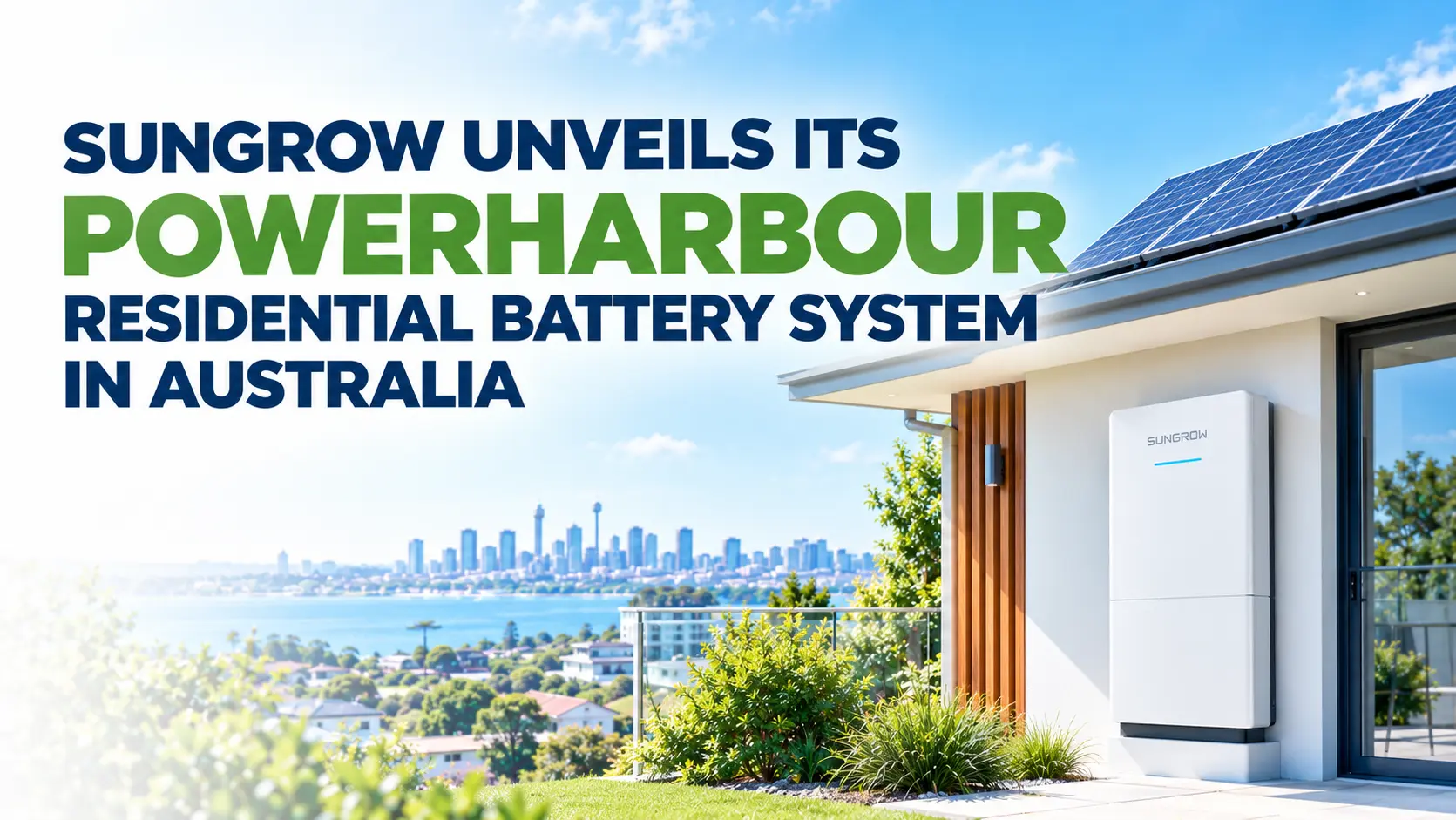
Australian households looking to run more of their homes on solar power could soon have another option, with Sungrow launching a residential battery system that can expand to 120 kilowatt-hours (kWh) and integrate electric vehicle charging in selected configurations.
The PowerHarbour system made its Australian debut at All-Energy Australia 2026 in Melbourne on 28 October. It combines a solar inverter, modular battery storage and intelligent energy management, giving households a way to store excess solar electricity and use it when demand rises.
The launch comes as more Australians consider batteries to get greater value from rooftop solar, particularly as electricity retailers change their feed-in tariffs and some offer free or cheaper electricity during certain daytime hours. For households planning to add an electric vehicle, heat pump or other power-hungry appliances, the question is no longer just how much solar they can generate, but how much of that energy they can use at home.
Sungrow says PowerHarbour is designed to help manage that shift, with storage that can grow alongside a household’s needs.
You may also want to read: What Are The Best Home Energy Saver Loan Upgrades To Make?
A Home Battery That Can Grow Beyond Typical Household Needs
Most households do not need to start with the largest battery available. Their electricity use, solar generation and evening demand all affect how much storage makes sense.
PowerHarbour takes a modular approach, allowing compatible battery modules to be added over time. Sungrow says supported configurations can reach up to 120 kWh of storage, using the integrated system alongside additional battery clusters.
That is a substantial capacity for a residential system and could interest larger homes with high electricity use, multiple electric vehicles or several electrically powered appliances. It may also appeal to households planning a gradual move away from gas.
The 120 kWh figure is a maximum for supported configurations, not the capacity of every standard installation. Buyers will need to check the available models, usable storage and installation cost before deciding whether the system suits their home.
Sungrow also says compatible new and existing battery modules can be combined without state-of-charge calibration or pre-charging. That could simplify future expansion, although compatibility depends on the equipment being installed.
Can AI Help Households Get More From Their Solar Panels?
Generating solar electricity during the day is only part of the equation. If a household exports much of that power and buys electricity back in the evening, the financial benefit depends on the price received for exports compared with the price paid for imported electricity.
PowerHarbour uses AI-driven energy management to analyse weather forecasts, expected solar generation, household consumption and electricity prices. Sungrow says the system uses this information to schedule when the battery charges and discharges.
In practice, that could mean storing excess rooftop solar for evening cooking, heating, cooling or charging an electric vehicle. Where electricity prices vary throughout the day, the system can also factor those changes into its energy scheduling.
The system supports solar panel capacity of up to 200% of the inverter’s rating in applicable configurations. This allows a larger solar array to be paired with the system, subject to the relevant product specifications.
However, smart controls do not guarantee lower bills. Actual savings will depend on a household’s electricity tariff, solar output, energy use, installation costs and how effectively the battery is used. Sungrow has not published a guaranteed bill-saving figure for Australian households in its launch announcement.
EV Charging Could Become Part of the Same System
PowerHarbour Pro brings another piece of the home energy puzzle into the system: electric vehicle charging.
Selected configurations combine the inverter, energy management system and EV charging hardware. This could make the platform attractive to homeowners who want their solar panels, battery and car charging to work together rather than operate as separate systems.
The launch also points towards future vehicle-to-everything (V2X) applications, which could allow compatible electric vehicles to exchange energy with a home or other connected systems.
There is a qualification buyers should know about. Sungrow lists the SHSA-Pro model as coming soon in its Australian product presentation. EV charging is available only in selected configurations, while V2X functionality depends on future product availability and compatibility.
The company’s announcement also cites Electric Vehicle Council figures showing battery electric and plug-in hybrid vehicles accounted for 34.5% of new vehicle sales in September 2026. That growing interest in electric transport gives integrated home charging a clearer role in residential energy planning.
Built for Outdoor Installation, With a Quieter Design
Battery location matters, especially when equipment needs to sit outside a home. Sungrow says PowerHarbour has an IP66 protection rating and C5 corrosion resistance, specifications intended to support operation in demanding environments.
The system uses battery cells rated at 314 amp-hours or higher, with stackable modules holding up to 10 kWh each. Some configurations have a depth of just 255 millimetres, although dimensions vary by model.
Sungrow also says operating noise is below 30 dB(A). For homeowners concerned about installing equipment near living areas, that is a useful specification to check against the final model’s datasheet.
For installers, the modular, plug-and-play design is intended to reduce wiring and installation complexity. Selected configurations include the EnergyBridge backup device, which consolidates five electrical functions into one unit. The iHomeManager Mini and iSolarCloud monitoring platform are designed to help installers commission the system and give homeowners visibility into solar generation, battery storage and electricity consumption.
These features may simplify installation, but the final setup still needs to match the home’s switchboard, existing solar equipment and backup-power requirements.
You may also want to read: NSW Home Energy Saver Loan for Solar and Battery Systems
What Sungrow Says About the Future of Home Energy
The company says its focus is on connecting technologies that households increasingly use together, rather than simply adding more features to individual products.
Scott Su, Technical Service Director at Sungrow Australia, said:
“Australia’s transition towards more connected home energy systems presents a significant opportunity for the industry. We believe the next step is not simply adding more features, but making solar, storage and energy management work together more effectively. With PowerHarbour, our focus is on bringing these technologies together in a practical, flexible solution that can support different household needs as the market evolves.”
The statement reflects a broader change in household energy: solar panels, batteries, electric vehicles and electric heating are increasingly part of the same investment decision. How well those technologies work together can matter as much as the specifications of any single device.
What Should Homeowners Check Before Buying?
Sungrow’s Australian launch announcement does not provide a complete price list or confirmed availability dates for every PowerHarbour configuration. Homeowners interested in the system should ask an installer which models are available, how much usable storage they provide and whether they can connect to an existing solar installation.
They should also compare the total installed price, warranty conditions, backup capability and any applicable government incentives. A larger battery is not automatically a better investment: households need enough electricity use at the right times to justify the extra capacity.
For homes planning to add an EV or heat pump, it is worth considering future electricity demand before settling on a system size. That can help avoid buying too little storage now or paying for capacity that may never be needed.
You may also read our other latest news: WA Moves to Legalise Plug-In Solar: Renters May Finally Get a Slice of the Sunshine
Victoria Expands Apartment Solar Rebates, Opening Access to Larger Buildings
FranklinWH Unveils Hybrid Battery System With Smarter Solar Controls
CleanSwitch Take: What We Think
The next stage of home electrification is about getting solar, batteries, EV charging and electric appliances to work together. Sungrow’s PowerHarbour is an interesting addition to that market because its modular design offers room for households to expand storage as their needs change.
But the headline figure of 120 kWh should not distract buyers from the basics. The right battery is the one that fits a household’s electricity use, solar generation and budget, with realistic savings after installation costs. Until Australian pricing and availability for each configuration are confirmed, homeowners should treat the launch as an option to investigate rather than a reason to rush into a purchase.
Our team at CleanSwitch will continue following new home battery launches, checking their costs and availability, and keeping you informed about the technologies and incentives that could make a real difference to Australian household energy bills.