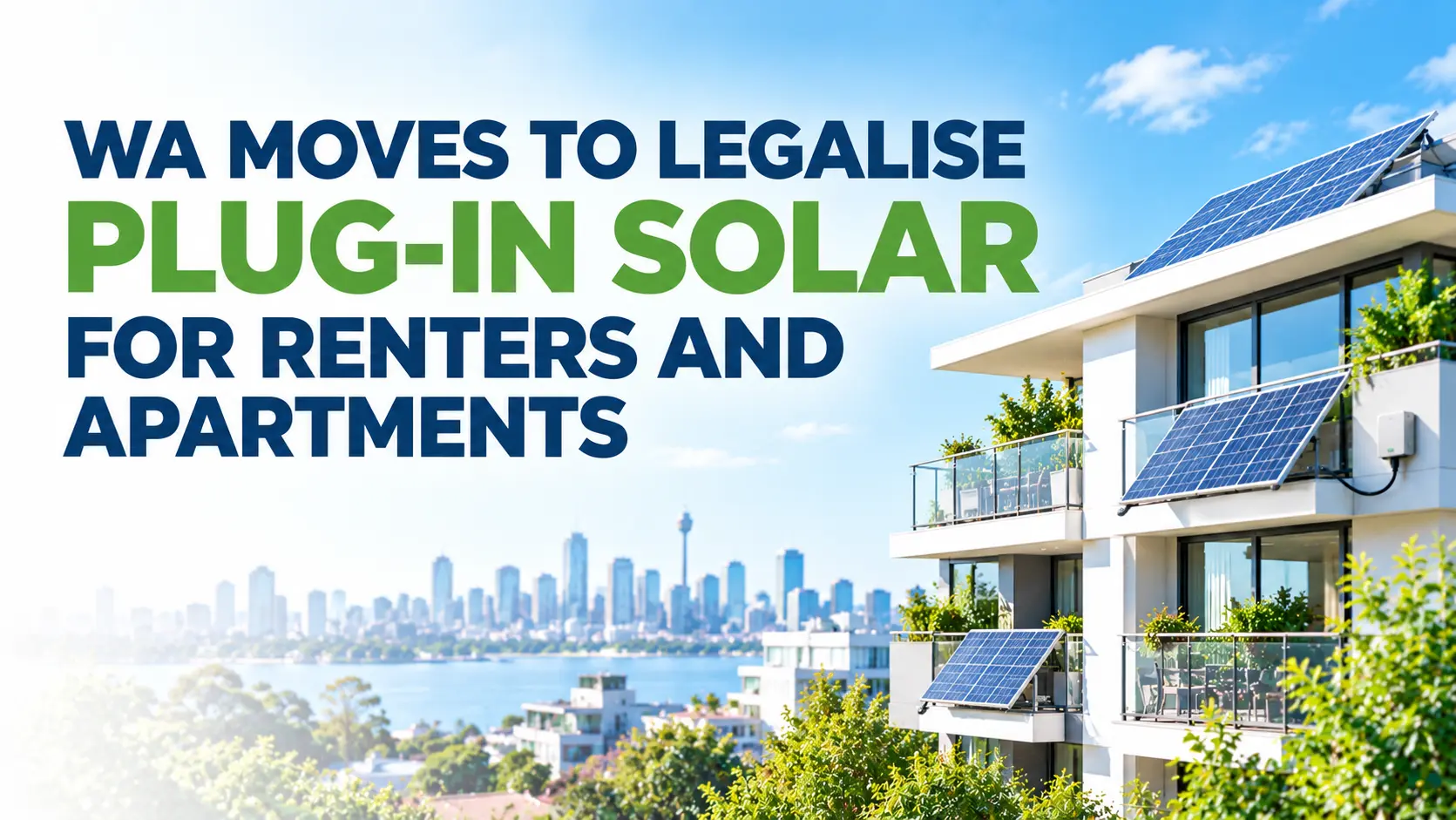
You can rent a home, pay the electricity bill and watch the sun pour onto your balcony. But putting that sunshine to work has not been as simple as plugging in an appliance. Western Australia now wants to change that.
In September, CleanSwitch reported on the national push to make balcony solar legal in Australia. Now, Western Australia has moved ahead with a state-level proposal, opening consultation on rules that could allow renters and apartment residents to use plug-in solar panels and batteries without installing conventional rooftop systems. The WA Government has confirmed the consultation is underway.
The proposal would make WA the first Australian state or territory to legalise the technology. But before households rush to turn their balconies into mini power stations, the state wants to settle an important question: how can these systems connect safely to household electricity circuits?
You may also want to read: What Are The Best Home Energy Saver Loan Upgrades To Make?
From a National Discussion to a WA Proposal
Our September report on balcony solar in Australia covered the national agreement to explore a safe pathway for plug-in solar and batteries. That was the starting point. Western Australia’s latest announcement moves the discussion towards the technical rules needed to make household use possible.
The state is proposing solar panel combinations with a rated capacity of up to 2 kilowatts (kW) DC and inverter units rated at up to 800 watts AC. The draft technical standard is based on an existing German standard, with additional provisions for battery storage. It would not set an upper limit on battery capacity.
These are proposed limits for Plug-in solar Western Australia, not final rules. The government is consulting on the legalisation pathway and technical standard before deciding how the systems can be approved for use in WA homes.
Why Renters Could Be Among the Biggest Winners
For homeowners, rooftop solar can turn an empty roof into an electricity generator. Renters do not always get that option. They may be unable to install permanent equipment, while apartment residents can face shared-roof restrictions and owners corporation rules.
Plug-in solar could offer a more portable alternative. Small panels can be positioned in a suitable sunny spot and connected through a compatible system. Add a battery, and some of the electricity can be stored for later use.
Commerce Minister Dr Tony Buti summed up the appeal in one sentence:
“A plug-in system arrives in a box and goes into a standard power point. When you move house, you take it with you.”
That portability could make a difference to people who move frequently or do not want to invest in equipment attached permanently to a property. But the final rules will still need to address electrical safety, and residents may need permission to place equipment on balconies or other shared areas.
The Numbers Behind the Proposed Rules
The draft standard sets two main limits:
- Solar panels: Up to 2 kW DC in combined rated capacity.
- Inverters: Up to 800 watts AC.
The proposal also accommodates batteries without setting an upper limit on storage capacity.
The inverter limit matters because connecting a generator to a household circuit raises safety questions that do not arise in quite the same way with an ordinary appliance. Regulators need to consider how electricity flows through the wiring, how protective devices respond and whether the system can operate safely under Australian conditions.
The consultation is intended to help resolve those questions before the rules are finalised. The WA Government’s consultation documents include the proposed technical standard and supporting material.
What Could It Mean for Electricity Bills?
The WA Government estimates that a typical plug-in solar system could save households around $240 a year, rising to approximately $500 with a battery.
Those figures are estimates rather than promises. Savings will depend on sunlight, panel placement, household electricity use, equipment costs and how much generated power the household consumes.
The government has not announced a dedicated rebate for plug-in solar under this proposal. Buyers will need to weigh the upfront cost against their likely savings rather than assume the system will pay for itself quickly.
Still, the attraction is easy to understand: even a relatively small system could offset part of the electricity a household buys from the grid.
WA Wants to Get the Rules Right
Western Australia already has a substantial household solar market. The government says more than 40 per cent of homes connected to the South West Interconnected System have rooftop solar, while more than 35,000 homes have installed batteries through the WA Residential Battery Scheme. These figures are outlined in the government’s original announcement.
Plug-in systems would target people who have largely been left out of that rooftop boom.
Energy and Decarbonisation Minister Amber-Jade Sanderson said:
“For too long, the benefits of cheap solar have been out of reach for anyone who doesn’t own their roof. That isn’t fair, and the Cook Labor Government is doing something about it.”
She added that the technology was already used in millions of European households and said WA wanted residents to have access to similar opportunities.
Buti also made clear that the government does not want to rush the process:
“Western Australia will be the first state in the country to make this legal and we want to ensure that it’s done properly.”
The consultation is being led by the Department of Energy and Economic Diversification and the Building and Energy division of the Department of Local Government, Industry Regulation and Safety. Submissions close at 5 pm AWST on 9 December 2026. The official consultation page provides the draft standard and submission details.
When Could Residents Plug In?
Not just yet. The government still needs to consider feedback, finalise the technical standard and complete the necessary regulatory changes. It has not announced a confirmed date for when approved systems could be used under the new pathway.
There are practical questions beyond the electrical standard, too. Landlords and apartment owners corporations may need to consider where panels are placed, how equipment is secured and whether building rules permit installations. The ABC’s report on WA’s proposal also examines the questions around safety and apartment access.
The proposal applies to Western Australia. Residents elsewhere in Australia should not assume the same rules will apply in their state or territory.
You may also want to read: NSW Home Energy Saver Loan for Solar and Battery Systems
CleanSwitch Take: What We Think
We think WA is right to open the door to renters who have been left out of the rooftop solar boom. You shouldn’t have to own a roof to make use of the sunshine above your head. But the final rules must keep households safe without making plug-in solar too expensive or complicated for ordinary people. Landlord and apartment restrictions also need attention, or some renters could remain locked out.
We’d like to see WA’s move encourage a nationally coordinated approach, so access to solar doesn’t depend on your postcode.
We’ll continue following the consultation, keep track of the government’s next steps and bring our readers the latest updates as the rules take shape.