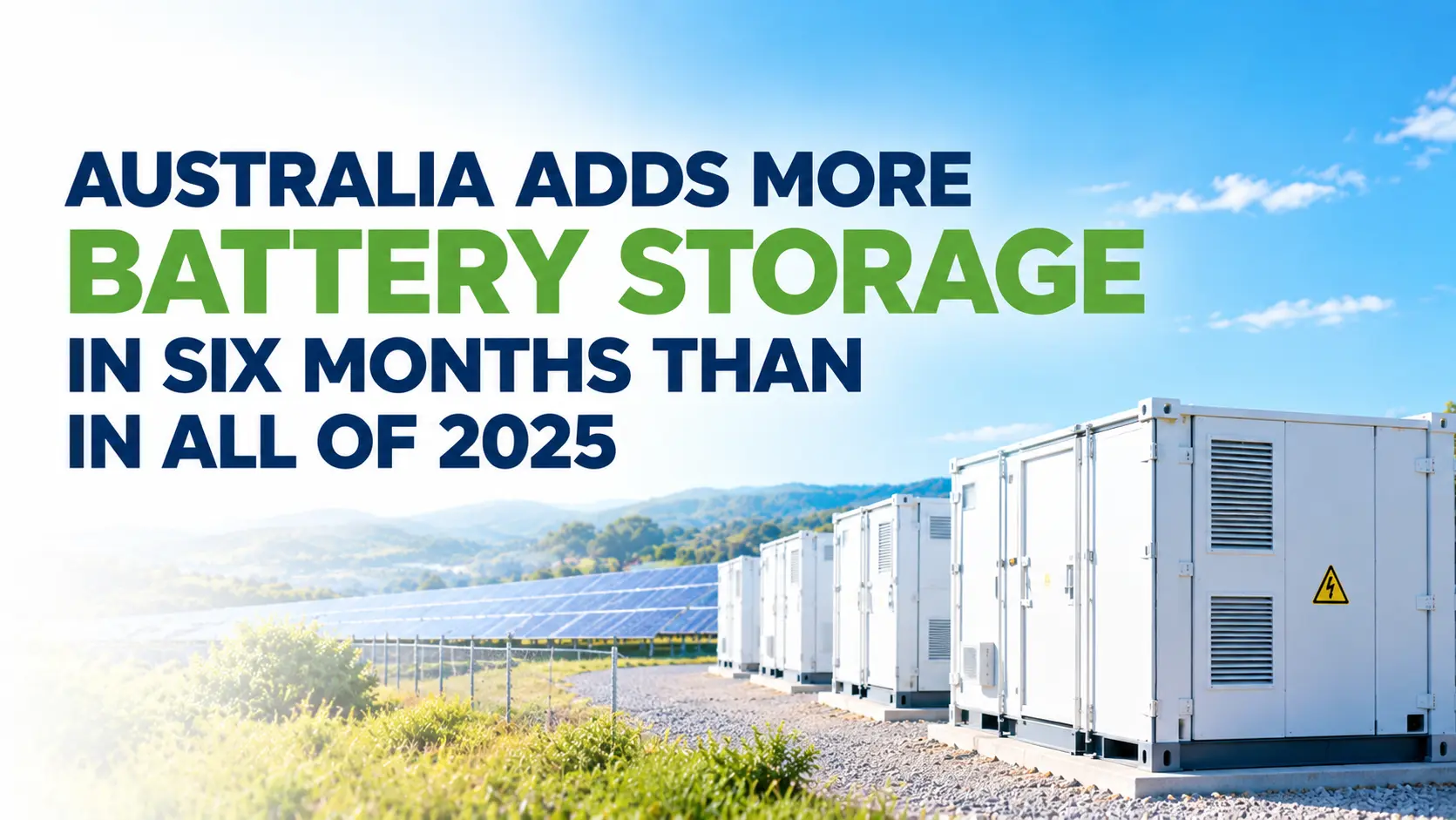
Australia added more large-scale battery storage in the first half of 2026 than it did during the whole of 2025. Investment in new generation also picked up, with solar farms and solar-and-battery projects accounting for most of the projects that secured financing.
The Clean Energy Council (CEC) reported on 26 October that nine large-scale batteries worth $4.3 billion had begun operating between January and June. Together, they added 2.3 gigawatts (GW) of power capacity and 7.1 gigawatt-hours (GWh) of storage. Across all of 2025, the country added 2 GW of battery power capacity and 5.1 GWh of storage.
The council’s latest investment report also found that 12 generation projects with a combined capacity of 2.6 GW reached final investment decision during the six months. That’s more than the 2.3 GW recorded across the whole of last year.
You may also want to read: What Are The Best Home Energy Saver Loan Upgrades To Make?
More Batteries Are Coming Online
The battery figures show how quickly large-scale storage is becoming part of Australia’s electricity system. These installations can absorb surplus electricity during periods of strong solar generation and release it when demand rises, including in the evening when rooftop solar produces less power.
Power capacity and storage capacity measure different things. A battery rated at 2.3 GW can deliver power at that rate, while its 7.1 GWh of storage indicates how much energy the nine projects can hold collectively.
For the grid, the value lies in being able to shift electricity from one part of the day to another. Batteries can help manage periods of high demand and make better use of renewable power that might otherwise be less useful when generation exceeds immediate demand.
CEC Chief Executive Jackie Trad said Australia’s renewable resources also offer some protection from international fuel disruptions.
“Australian sun and wind cannot be cut off by conflict overseas. Each new solar, wind and battery investment helps make Australia more energy independent and economically resilient, shielding Australians from global fossil fuel price shocks and supply disruptions,” she said.
You may also want to read: Battery Projects Push Australia’s Energy Connection Pipeline to Record 80.9 GW
Solar Projects Lead New Investment
Solar is also driving much of the investment in new electricity generation. Of the 12 projects that reached final investment decision in the first half of 2026, 11 were solar farms or hybrid solar-and-battery projects.
Five generation projects with a combined capacity of 1.4 GW and worth more than $2.8 billion began operating during the same period. They included the first 756 MW stage of Victoria’s Golden Plains Wind Farm, which is expected to produce enough electricity to power more than 400,000 homes.
These operating projects are different from those that have only secured financing. A final investment decision means developers have committed to proceed, but construction and grid connection may still lie ahead.
That distinction matters when assessing how quickly investment can strengthen electricity supply. Money committed to a project is a positive sign, but the electricity becomes available only when the project is built and operating.
Queensland Leads Investment, While NSW Has the Largest Battery Pipeline
Queensland recorded $9.6 billion in generation and storage projects that were either under construction or at financial close, representing 4.5 GW of capacity. New South Wales had the largest battery pipeline, with 4.3 GW of power capacity and 11.2 GWh of storage.
Across the country, 141 generation and storage projects worth around $32.5 billion were under construction or at financial close, according to the CEC.
Trad said keeping investment moving would require governments and industry to address barriers that can hold projects back, particularly approvals and transmission infrastructure.
“With $32.5 billion worth of generation and storage projects now under construction or at financial close, maintaining this momentum will require predictable approvals, timely transmission and long-term revenue certainty to help more projects, including onshore wind, progress into operation,” she said.
New solar farms, wind farms and batteries need suitable grid connections to deliver their electricity to homes and businesses. If transmission infrastructure or approvals are delayed, projects can take longer to start supplying power, even when investors are ready to proceed.
You may also read: Some Battery Models Have Just Been Banned From NSW’s Energy Scheme: What Homeowners Need to Know
Wholesale Prices Have Fallen, but What About Household Bills?
Wholesale electricity prices averaged $74 per megawatt-hour in the June quarter, nearly 50% below the same period in 2025, the CEC reported.
Trad said increased renewable generation and storage were already putting downward pressure on power prices. When solar and wind supply more electricity, they can reduce the need for more expensive generators. Batteries can then store some of that electricity and release it when demand rises.
The wholesale price, however, isn’t the same as the price households see on their bills. Retail electricity costs also include network charges and other expenses, and those costs vary across regions. A fall in wholesale prices therefore doesn’t guarantee an equivalent reduction in household bills.
For consumers, the longer-term question is whether new generation, storage and transmission can keep pace with electricity demand while older power stations retire. The investment figures show progress, but the projects still being built or awaiting further development will also need to reach operation.
More latest news from our team: NSW Home Energy Saver Loan for Solar and Battery Systems
CleanSwitch Takeaway
More large-scale batteries are now operating in Australia, while solar projects continue to lead new generation investment reaching financial close. The next challenge is getting these projects through construction and grid connection so the electricity system can use the additional capacity.
Wholesale electricity prices have fallen sharply compared with a year earlier, but that does not guarantee the same reduction in household bills. Retail prices also reflect network charges and other costs, so the impact on consumers will depend on how changes in the electricity market flow through to energy plans.
CleanSwitch will continue tracking Australia’s battery, solar and wind projects to explain how the electricity system is changing and what these developments could mean for household energy costs.