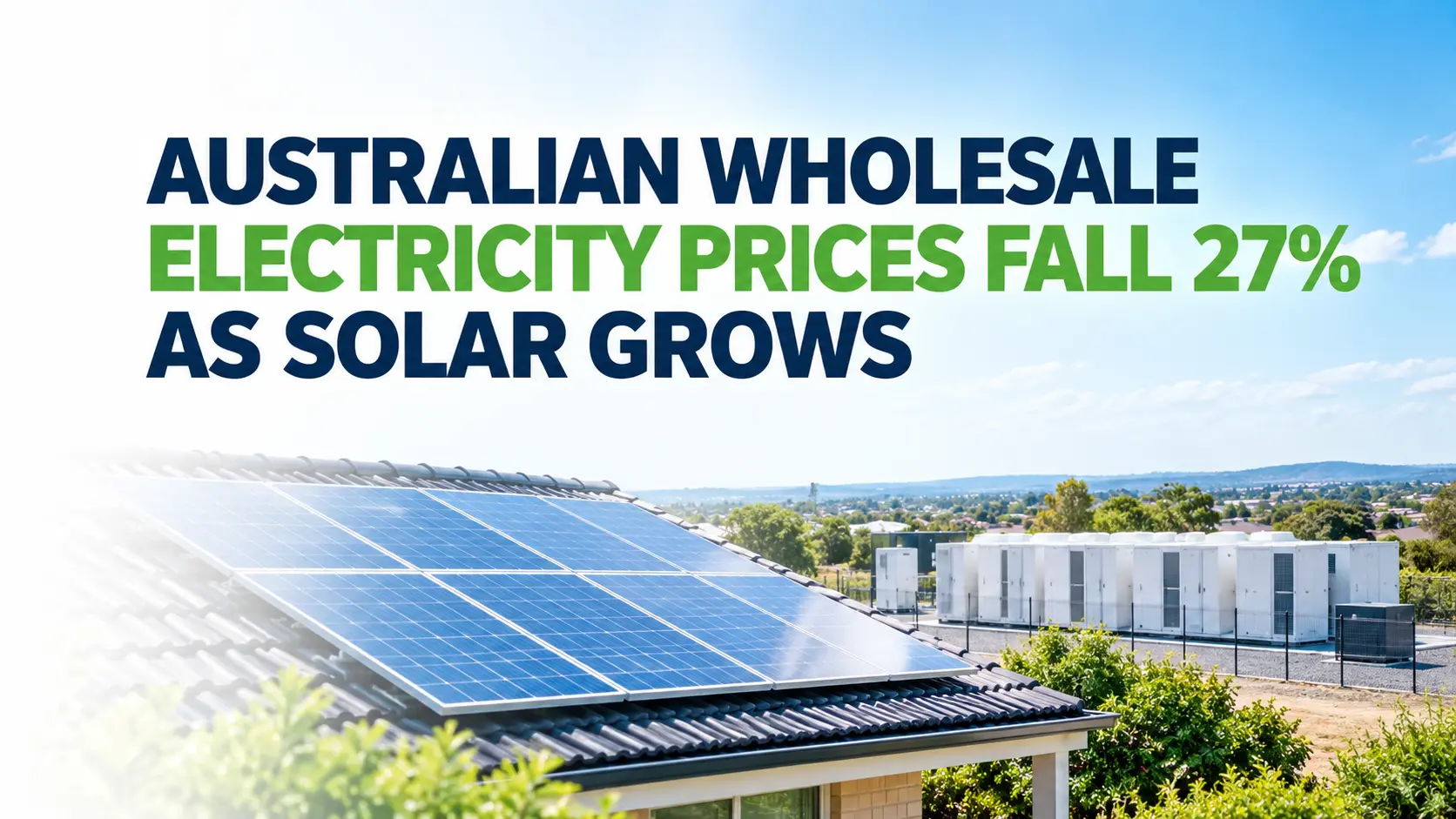
Australian wholesale electricity prices fell 27% in the September quarter as solar generation and battery storage grew and reshaped the National Electricity Market (NEM), despite electricity demand reaching a record high.
The Australian Energy Market Operator (AEMO) reported that average wholesale prices across the NEM dropped to $63 per megawatt-hour (MWh), the lowest September quarter average since 2021. Its Quarterly Energy Dynamics report for Q3 2026, released on 23 October, also recorded a new September quarter high for renewable generation and a sharp fall in gas-powered generation.
You may also want to read: What Are The Best Home Energy Saver Loan Upgrades To Make?
Wholesale Electricity Prices Fall Across the NEM
Average wholesale electricity prices fell 27% year-on-year and 15% from the June quarter. Victoria and Tasmania averaged $56/MWh, down 27% and 38% year-on-year, respectively. Queensland averaged $61/MWh, down 15%, while South Australia reached $69/MWh, down 34%. New South Wales averaged $74/MWh, a 17% decline.
The falls coincided with increased renewable generation and battery activity, while warmer winter conditions reduced heating requirements. However, underlying electricity demand still increased 1.3% year-on-year to a record Q3 average of 25,471 megawatts (MW).
Victoria accounted for almost all the demand growth, reflecting electrification, higher industrial demand and increasing data centre consumption. Data centre electricity consumption rose 65% year-on-year to an average of 225 MW.
The figures show how record electricity use can coincide with lower wholesale prices as rooftop solar supplies more electricity directly to homes and businesses, while grid-scale generation and storage change how supply meets demand.
You may also want to read: European Energy Signs 30-Year Agreements for Three Queensland Solar and Battery Projects
Batteries Play a Growing Role in Evening Electricity Supply
Grid-scale batteries supplied 8% of evening peak generation between 4 pm and 9 pm, exceeding gas-powered generation at 5.1%. AEMO reported that this was the first quarter in which batteries supplied a greater share of evening peak generation than gas.
Energy shifted by grid-scale batteries more than tripled year-on-year. Increased battery charging and discharging also contributed to lower evening peak prices, with batteries setting prices in almost half of dispatch intervals, compared with 18% a year earlier.
AEMO Executive General Manager of Policy and Corporate Affairs Violette Mouchaileh said the growing contribution from solar and storage was changing when electricity was produced and drawn from the grid.
“Electricity use continues to grow, but more solar and storage is changing when energy is produced, drawn from the grid and shifted across the day,” Ms Mouchaileh said.
AEMO’s sample data also showed that households with rooftop solar and batteries drew around three-quarters less electricity from the grid during evening peaks than households with rooftop solar alone.
Renewable Generation Sets a New Quarterly Record
Renewable sources supplied a record 44.3% of NEM generation during the September quarter, up from 41.8% in the same quarter of 2025.
Grid-scale solar generation increased 30% year-on-year, while hydropower rose 15%. Gas-powered generation fell 34% to its lowest September quarter average since 2000.
The growing contribution from solar and batteries formed part of a wider change in Australia’s electricity mix, with storage shifting more renewable energy into periods when demand is higher.
Western Australia Records Higher Wholesale Prices
Wholesale electricity prices did not fall across every Australian market. In Western Australia’s Wholesale Electricity Market (WEM), average real-time prices increased 19% year-on-year to $120.72/MWh, the highest quarterly average recorded in the market.
AEMO attributed the increase partly to weaker wind conditions and reduced coal availability, which increased reliance on gas-powered generation. Although battery charging doubled and discharging increased 98%, the market experienced higher average prices than a year earlier.
The contrast highlights the different conditions shaping Australia’s electricity markets. While growing solar generation and battery storage coincided with lower NEM wholesale prices, fuel availability and weather conditions contributed to a different result in Western Australia.
Latest news you might find interesting: Australia Backs 360 MWh Heat Battery to Cut Emissions at Queensland Refinery
CleanSwitch Take: What We Think
AEMO’s September quarter findings show how solar generation and battery storage are reshaping Australia’s electricity markets. Wholesale prices across the National Electricity Market fell 27% to $63/MWh despite record underlying demand, while renewables supplied a record 44.3% of generation and grid-scale batteries overtook gas in their share of evening peak generation.
However, the trend was not consistent across Australia. Wholesale prices in Western Australia rose 19% as weaker wind conditions and reduced coal availability increased reliance on gas-powered generation. The contrast highlights how weather, generation availability and storage influence electricity prices in different markets.
For households, lower wholesale prices do not automatically mean lower electricity bills. CleanSwitch will continue tracking Australia’s energy market and reporting on developments that could affect household energy costs.