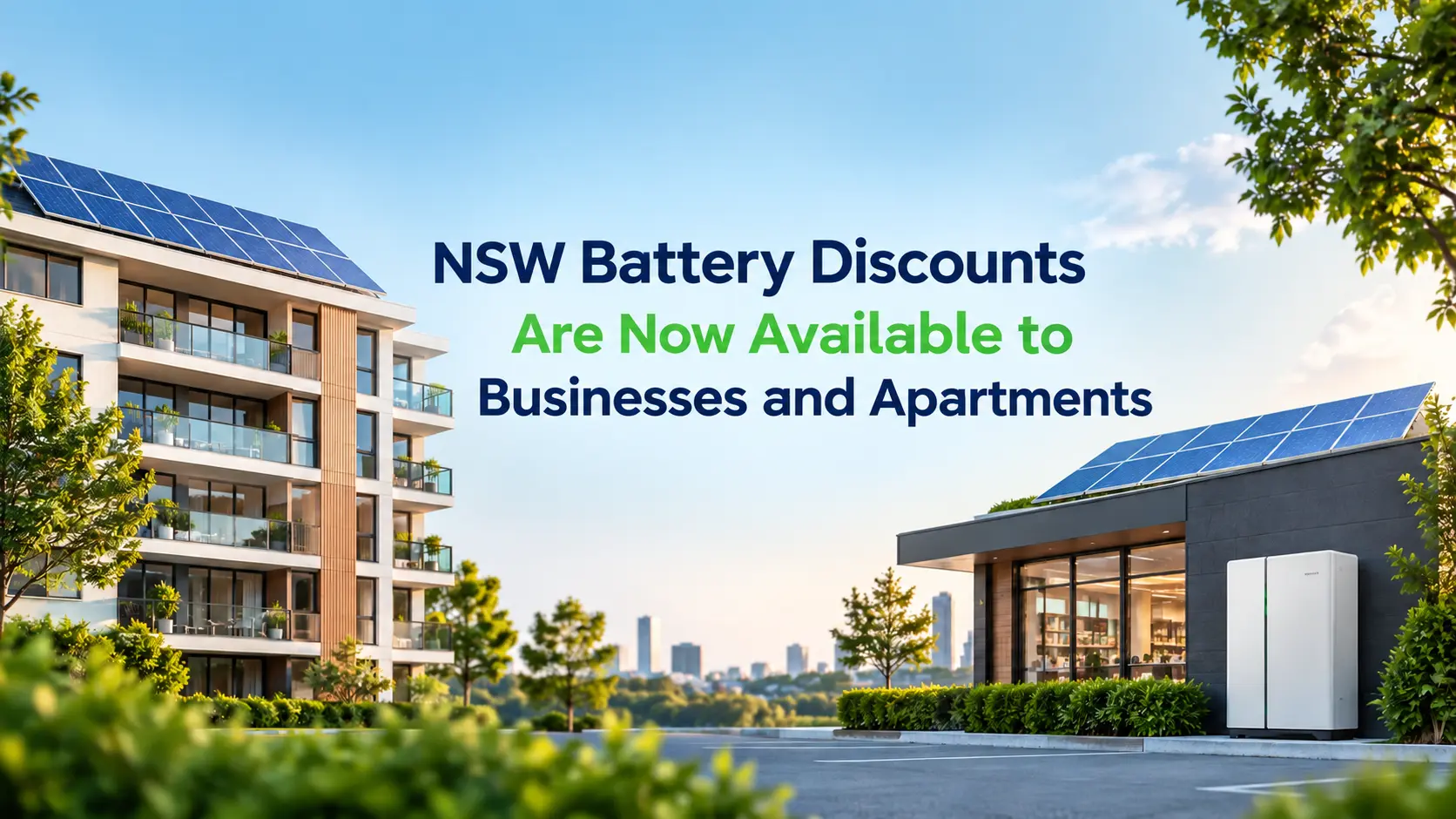
Businesses and apartment buildings across NSW can now access upfront discounts on new battery installations, with eligible projects able to receive around 20% to 40% off the cost of installing a battery.
The new incentives began on 1 September 2026 and are being offered through accredited suppliers under the NSW Government’s Peak Demand Reduction Scheme. The program is designed to increase battery storage in businesses and apartment buildings while helping reduce electricity demand during peak periods.
For businesses, eligible battery installations range from 20kWh to 30MWh. Apartment buildings with at least four units can access the incentive for batteries between 20kWh and 200kWh.
What Has Changed?
The new NSW incentive reduces the upfront cost of installing a battery at an eligible business or apartment building.
The current program provides an indicative discount of about 20% to 30% for battery-only installations, rising to about 30% to 40% when a new or additional solar system is installed with the battery. The final discount depends on factors including the battery, property, installation and installer.
The NSW Government’s original announcement gave examples of the potential value of the support. A small business such as a grocery store could receive a discount of around $37,000, while a medium-sized business such as a dairy farm could receive around $355,000. These are government examples rather than fixed amounts available to every business.
NSW Minister for Climate Change and Energy Penny Sharpe said the changes were intended to make battery storage more accessible across businesses and apartment buildings.
““NSW wants more batteries, and these changes will help more people cut their power bills, whether they are running a business or living in an apartment.”
The government has not set a current closing date for the business or apartment battery discounts. They operate under the Peak Demand Reduction Scheme, which is reviewed over time.
Who Can Access the Battery Discount?
Businesses
Businesses in NSW may qualify if they install a battery between 20kWh and 30MWh, have not already used the discount for a battery and meet the scheme’s other requirements. They also need to use an installer offering the incentive and obtain any required approvals.
The program covers a wide range of battery sizes. A 20kWh to 50kWh battery, for example, could suit smaller businesses such as restaurants, takeaway shops and convenience stores, while larger commercial and industrial operations can install much larger systems.
Businesses can receive a larger discount when they install new or additional solar alongside the battery. Where a business already has solar, the NSW Government says additional solar capacity must be installed within 90 days before or after the battery, with the new solar meeting the scheme’s capacity requirement.
Apartment Buildings
Apartment buildings can also access the incentive, but the eligibility rules are different.
The building must have at least four units, while the battery must have usable capacity between 20kWh and 200kWh. The battery must also meet the scheme’s approval and installation requirements.
The discount applies to the building rather than an individual apartment. That means the owners corporation has an important role in deciding whether to proceed. The NSW Government says the owners corporation must vote on the preferred installation as part of a sustainability infrastructure resolution.
Buildings without solar can still receive the battery discount, although the incentive is larger when new or additional solar is installed within the required 90-day period.
Why Is NSW Encouraging More Batteries?
The policy is part of NSW’s broader effort to reduce electricity demand during peak periods.
A battery can store electricity for later use, including solar generation produced during the day. For a business, that can allow more of its solar power to be used later rather than exported immediately.
At the grid level, batteries can also help shift stored electricity into periods when demand is higher. The Peak Demand Reduction Scheme now includes battery installations in businesses and apartments among the activities eligible for incentives.
The NSW Government says battery uptake is already growing rapidly, with around 10,000 new home batteries being installed each month. It is now using the state scheme to encourage storage in parts of the market that may not qualify for the federal household battery program.
Sharpe said the government expects the changes to have wider economic benefits for businesses.
““The Minns Labor Government will help businesses unlock major savings through renewable energy, reducing their long-term operating costs, improving competitiveness and supporting jobs across NSW.”
That is the government’s stated rationale for the business component of the policy. The actual financial benefit for an individual business will depend on its electricity use, solar generation, battery size, installation costs and the discount included in its quote.
What Does the Change Mean for Businesses and Apartments?
For businesses, the new incentive changes the upfront cost calculation for battery storage. A battery may make more sense where a business has significant daytime solar generation and electricity demand that continues into the evening.
However, the discount alone does not determine whether a battery will pay off. Businesses still need to consider their electricity consumption, existing solar system, battery size, electricity prices and installation requirements.
Apartment buildings face a different set of considerations. Owners corporations need to look at shared electricity use, available installation space, existing solar, electrical infrastructure and how the stored energy will be used across the building.
The NSW Government recommends getting multiple quotes from installers offering the discount. The incentive should appear as a separate item in the quote, while the final amount can vary depending on the property, battery, installation and installer.
Batteries Are Becoming Part of NSW’s Wider Energy System
The new discounts are part of a broader shift in how NSW is using battery storage.
Solar can generate large amounts of electricity during the day, while batteries can store some of that energy for later. Virtual power plants can then connect participating batteries so stored electricity can be coordinated with the needs of the wider electricity system.
NSW has also expanded its Peak Demand Reduction Scheme to cover batteries in businesses and apartments, alongside other measures such as virtual power plants and large air conditioners.
For businesses and apartment buildings, the immediate change is the lower upfront cost. The bigger story is that battery storage is becoming a more significant part of NSW’s approach to managing electricity demand as more renewable generation enters the system.