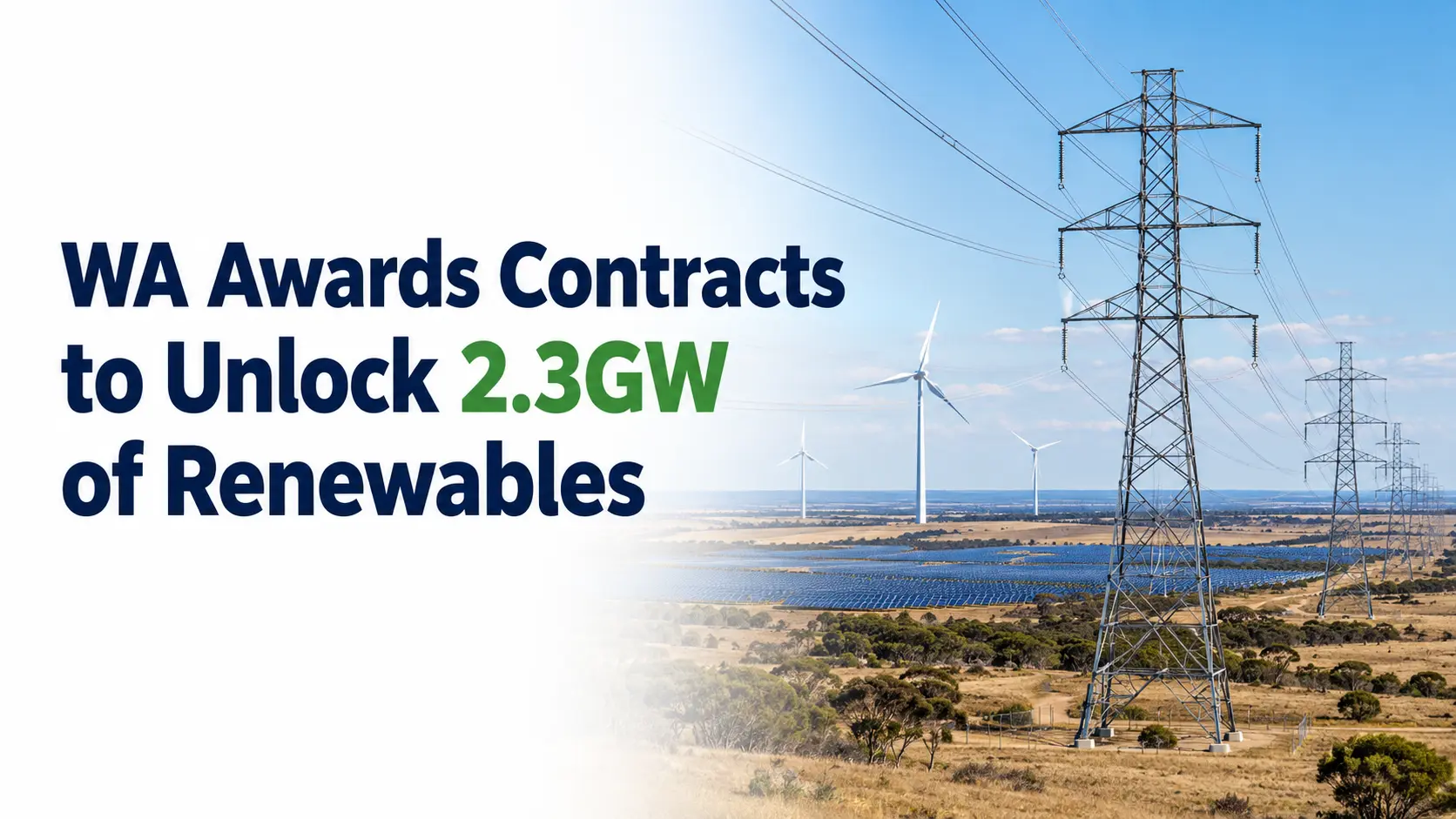
Western Australia has selected three contractors to build new transmission infrastructure designed to unlock 2.3 gigawatts (GW) of renewable energy capacity, as the state prepares its electricity grid for more wind and solar power.
The Clean Energy Link – East (CEL – East) project will involve new high-voltage transmission lines and terminal upgrades near Collie, helping move electricity from renewable energy projects in the eastern and south-eastern regions of the South West Interconnected System to homes and businesses.
Announced on 14 October, the contract award names Acciona, GenusPlus and UGL Engineering as delivery partners for the project’s first stage. The work is expected to support 300 jobs initially, rising to 600 at the peak of construction, according to the Western Australian Government.
However, the immediate development is about expanding the electricity network, rather than adding 2.3 GW of new renewable generation overnight. The infrastructure must be delivered before more wind and solar projects can use the additional network capacity.
You may want to read: Victoria Approves 1.5 GW Wind Farm With 600 MW Battery Storage
What Will the Clean Energy Link – East Project Deliver?
The first stage will strengthen transmission connections between Collie and Darkan through a new terminal at Cordering and upgrades to existing facilities at Shotts and Muja.
The contracted work includes:
- A new 330-kilovolt (kV) terminal at Cordering.
- Expansions of the Shotts and Muja terminals.
- 38 kilometres of 330 kV transmission lines between Shotts and Cordering.
- 54 kilometres of 330 kV transmission lines between Muja and Cordering.
These connections are intended to increase the grid’s capacity to carry electricity from renewable energy developments into the wider network. Western Power’s Clean Energy Link – East project overview says the first stage is expected to unlock approximately 2.3 GW of renewable energy capacity, equivalent to the electricity use of around one million homes.
That figure describes the project’s expected potential, not a guarantee that one million households will receive lower bills. The actual impact will depend on which generation projects connect, how much electricity they produce, network conditions and the cost of supplying power.
Western Power’s transmission lines project information also provides further details about the planned infrastructure and project delivery.
Premier Says Project Will Support Up to 600 Local Jobs
Premier Roger Cook linked the transmission investment to Western Australia’s energy supply, industrial development and employment prospects.
“We’re building a State of Energy in Western Australia, securing affordable, reliable, and lower carbon energy for WA households and businesses through renewables, backed by battery storage and flexible WA gas,” Cook said in the government announcement.
The project is expected to provide work during construction and opportunities for businesses supplying equipment, services and technical skills. Its longer-term role is to make it easier for additional renewable energy projects to connect to the grid.
Energy and Decarbonisation Minister Amber-Jade Sanderson also connected the project to household energy costs, saying: “Clean Energy Link – East will deliver more affordable energy to WA households, while supporting local jobs and local businesses.”
That is the government’s stated expectation. The contract announcement does not quantify potential household savings or establish when consumers might see any price effect.
The contractors’ roles are also outlined in industry reporting. For further details on UGL’s contract packages, see the CIMIC Group announcement.
Western Power’s Local Spending Rises Above $1.3 Billion
The contract announcement coincided with new figures showing Western Power spent more than $1.3 billion with local businesses during the 2025–26 financial year, compared with $850 million in the previous financial year.
More than 290 Western Australian businesses supplied materials, services and skills to support the electricity network, according to the government.
The figures add an economic dimension to the transmission project: the grid expansion requires major infrastructure, while the broader procurement program directs spending towards businesses operating in the state.
One example cited by the government is Bunbury-based Geographe Underground Services. Its work with Western Power on infrastructure in the Mundijong West Industrial Area has supported 40 local jobs and helped the company expand its horizontal directional drilling capabilities.
The government said a ministerial direction issued in December 2025 requires government trading enterprises to prioritise local businesses when considering work opportunities.
However, the $1.3 billion figure covers Western Power’s broader local procurement, not spending exclusively on Clean Energy Link – East. Keeping those figures separate is important when assessing the economic contribution of the new contracts.
Related news: ESYsunhome Updates HM Solar Battery Range With Higher Peak Output
What Does the Project Mean for WA’s Energy Transition?
Clean Energy Link – East is part of a wider transmission expansion intended to connect more renewable generation to the South West Interconnected System. Alongside Clean Energy Link – North, it is designed to increase the network’s ability to carry renewable electricity to customers and support the planned transition away from state-owned coal generation.
For households, the potential benefit is access to a more diverse electricity supply. But additional transmission capacity alone does not guarantee cheaper power: generation costs, demand, storage, network investment and the timing of coal retirements will also influence the outcome.
Western Power’s project information says construction timing is subject to approvals, so the planned capacity should be viewed as a future outcome rather than an immediate change to electricity supply.
What We Think
The Clean Energy Link – East contracts mark a practical step towards connecting more wind and solar power to Western Australia’s electricity grid. The 2.3 GW target gives the project scale, while the local procurement figures show how electricity infrastructure spending can also support businesses and construction jobs.
The bigger test will be whether the network upgrades are completed on schedule, renewable projects connect as planned and the expanded system delivers reliable electricity at a competitive cost. We’ll be following the construction timeline and the next renewable projects seeking to use the new capacity to see how those promises develop.