
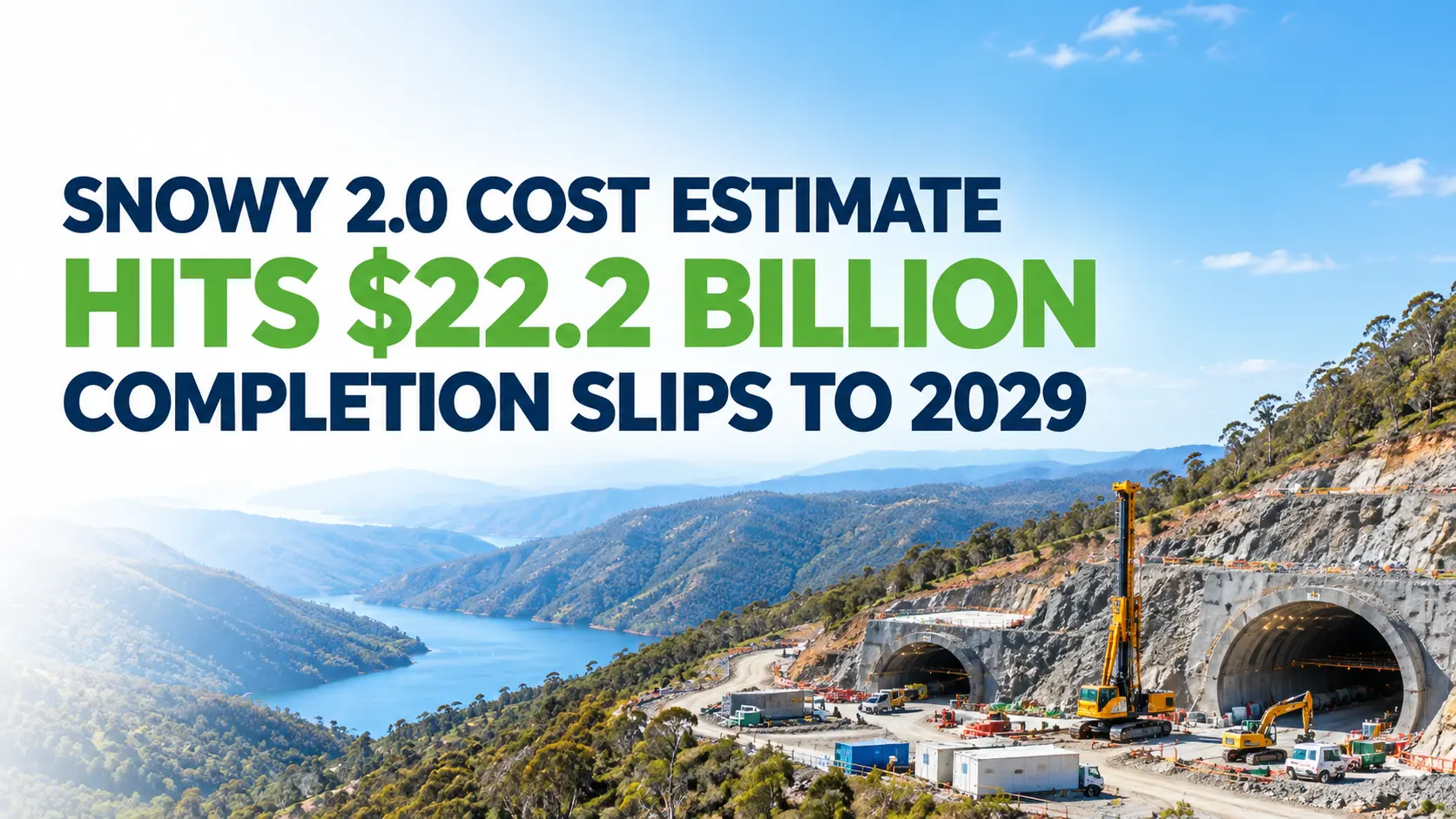

Australia’s Snowy 2.0 pumped hydro project now has a target cost of $22.2 billion, with an allowance for a higher-cost scenario reaching $25 billion. The project is targeting full commissioning in late 2029, following another reassessment of its construction costs and delivery schedule, according to Snowy Hydro’s announcement on 22 October 2026.
The revised figures represent a substantial increase from the project’s original $2 billion headline estimate in 2017. The Australian Government confirmed the updated cost and schedule in its joint media release on 23 October, citing construction cost pressures, difficult geological conditions and shortcomings in the project’s original design development.
Snowy 2.0 is designed to provide large-scale, long-duration energy storage as Australia increases its use of renewable electricity. However, the latest cost increase raises further questions about how much the project will ultimately cost and whether its expected benefits will justify the investment.
You may also want to read our other latest news: Australian Wholesale Electricity Prices Fall 27% as Solar Grows
Snowy 2.0 Cost Rises from $2 Billion to $22.2 Billion
The latest target cost is more than 11 times the project’s original $2 billion headline estimate in 2017. The figure rose to $6.1 billion at the December 2018 final investment decision before reaching approximately $12 billion during a 2023 cost reset, according to the Australian Government’s project update.
The new $22.2 billion target follows a detailed reassessment of the remaining work by principal contractor Future Generation Joint Venture (FGJV). Snowy Hydro said the increase reflects the project’s technical complexity, construction challenges, contractor productivity shortfalls and global cost increases for equipment, services and labour.
The company has also allowed for a cost scenario of $25 billion. This is a higher-cost allowance rather than a confirmed final bill.
Snowy Hydro chief executive Dennis Barnes said the cost increase was disappointing but argued that revised contracting arrangements had limited the potential impact.
“I have no doubt that moving from a fixed price contract, which was never suitable for such scale, uniqueness and complexity, has protected the project from an even greater cost increase,” Mr Barnes said in the company’s cost reassessment announcement.
The reassessment found that design immaturity at the original investment decision, construction complexities and previous underestimation of the delivery scope had contributed to the increase. Global cost escalation also exceeded the allowances made during the 2023 reset.
Construction Progresses as Commissioning Moves to Late 2029
Snowy 2.0 is now targeting full commissioning in late 2029, extending the wait for the project’s planned generation and storage capacity.
Despite the schedule change, construction has advanced since the 2023 reset. Snowy Hydro reports that machine tunnelling is 65% complete, excavation of the underground power station complex has reached 90%, and construction design is 96% complete, compared with 44% at the reset. These figures are detailed in Snowy Hydro’s latest project update.
More than 5,000 people are working on the project, which will expand the existing Snowy Scheme in New South Wales. Once operational, Snowy 2.0 is designed to provide around 2,200 megawatts of generation capacity and 350,000 megawatt-hours of energy storage.
The pumped hydro system will use electricity to pump water uphill when power is available, then release it through turbines to generate electricity when demand rises. This allows the facility to store and deliver energy over longer periods than many conventional battery systems.
However, construction progress does not remove the remaining delivery risks. The latest reassessment shows how geological conditions, design decisions and contractor performance can affect both the cost and timing of major underground infrastructure.
You may also want to read: What Are The Best Home Energy Saver Loan Upgrades To Make?
Snowy Hydro Projects Billions in Economic and Electricity Market Benefits
Snowy Hydro argues that the project’s long operating life will help support Australia’s electricity system as the share of renewable generation increases.
In the company’s announcement, Mr Barnes described the project’s storage capacity as a long-term contribution to energy reliability.
“The scale of Snowy 2.0’s energy storage is world-leading. More than half of the total energy storage the grid needs by 2050 will come from Snowy 2.0 alone,” he said.
That figure is Snowy Hydro’s projection of future storage requirements, rather than a measure of the project’s current contribution or a guaranteed outcome.
An independent economic assessment by GHD, released alongside the revised project figures, estimates that Snowy 2.0 will contribute $18.3 billion to the Australian economy during delivery and reduce wholesale electricity costs by more than $7 billion through 2075. The Australian Government cited these findings in its 23 October joint media release.
These estimates depend on the project reaching completion and operating under assumptions about commissioning, transmission infrastructure, electricity market conditions and government policy. They should therefore be understood as projected benefits rather than guaranteed savings for households.
The cost reassessment also leaves questions about how the revised project will be funded. Snowy Hydro said the $22.2 billion target cost is not the amount that must be funded by taxpayers. At the previous $12 billion estimate, around $4 billion came from Commonwealth investment that the company did not need to repay, with the remainder funded through loans and the company’s own cash flows.
The company says work is under way on the Commonwealth’s preferred capital strategy for the updated cost. The final funding arrangements will be important in determining how the additional expense is managed.
Related news you may find interesting: Australia Backs 360 MWh Heat Battery to Cut Emissions at Queensland Refinery
Why Long-Duration Storage Matters as Renewables Grow
Solar and wind generation can reduce reliance on fossil fuel generation, but their output changes with weather and time of day. Electricity systems therefore need sufficient storage, flexible generation and transmission capacity to balance supply and demand when renewable output falls.
Snowy 2.0 is designed to store large quantities of electricity and release them when the grid needs additional supply. This could help manage extended periods of low wind and solar output, reduce reliance on expensive generation during peak periods and support electricity system reliability.
However, Snowy 2.0 is not the only technology available to meet those needs. Grid-scale batteries, other pumped hydro projects, transmission upgrades and demand management can also support the electricity system. Their relative contribution will depend on cost, location, operating duration and future demand.
The project’s revised cost and schedule make delivery performance a central part of the debate. Its eventual value will depend on whether the completed facility provides the expected reliability and market benefits at a cost that can be justified against other options.
CleanSwitch Take: What We Think
Snowy 2.0 remains a major part of Australia’s long-duration energy storage plans, but its $22.2 billion target cost, allowance for a $25 billion cost scenario and late 2029 commissioning schedule highlight the challenges of delivering large energy infrastructure projects.
An independent GHD assessment projects an $18.3 billion contribution to the Australian economy and more than $7 billion in wholesale electricity cost reductions through 2075. These benefits depend on successful project delivery and future market conditions, so they should not be treated as guaranteed savings for households.
CleanSwitch will continue following Australia’s energy transition, keeping readers informed about major projects and policy decisions that could affect electricity reliability and household energy costs.