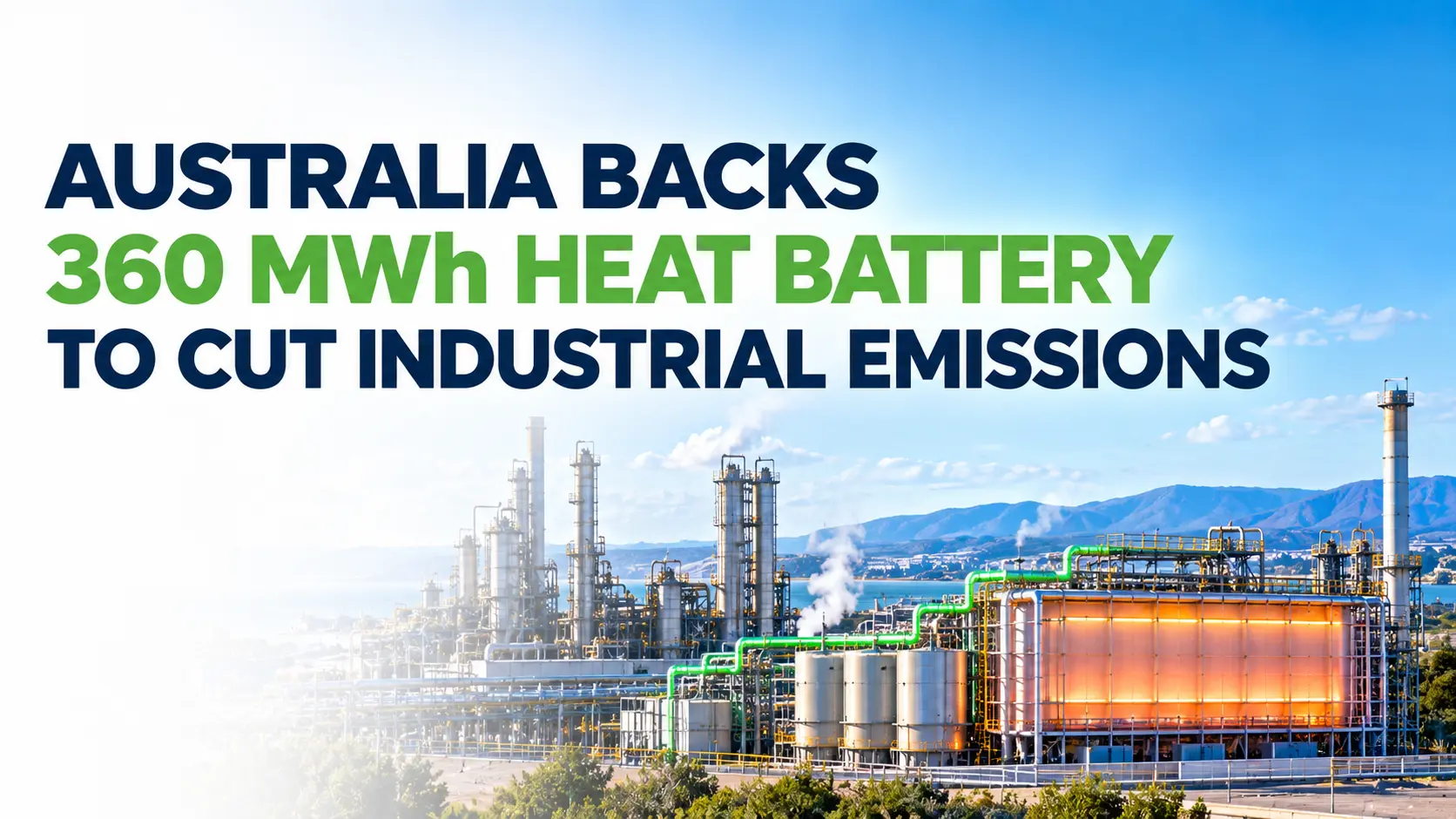

Australia is backing a major industrial heat battery project at Rio Tinto’s Yarwun alumina refinery in Gladstone, Queensland, with the proposed system expected to reduce on-site emissions by around 67,000 tonnes of carbon dioxide a year.
Announced on 21 October 2026, the project will receive an initial $3.6 million in funding from the Australian Renewable Energy Agency (ARENA) for engineering and design work. If the study is successful and the project proceeds, ARENA will provide up to $38 million for construction and commissioning, alongside up to $33.3 million in conditional contingency support.
The project will test whether electricity stored as heat can replace some of the fossil fuels used to produce the high-pressure steam required for alumina refining.
You may also want to read: European Energy Signs 30-Year Agreements for Three Queensland Solar and Battery Projects
How Will the Heat Battery Work?
The proposed 360 megawatt-hour (MWh) Rondo Heat Battery will connect to the refinery’s existing steam system. It will use electricity to store energy as high-temperature heat, then release that heat when the refinery needs steam for its operations.
This approach could help industrial facilities make better use of cheaper electricity when it is available, including during periods of strong renewable energy generation. Instead of relying entirely on fossil fuels to produce industrial heat, the refinery could use stored electricity to meet part of its steam demand.
According to ARENA’s project announcement, the system will have a thermal discharge capacity of 30 megawatts and an electrical charging capacity of 78 megawatts.
However, the project remains at the engineering and design stage. The study will assess whether the technology can integrate with the refinery’s operations and provide a technically and economically viable alternative to fossil fuels.
What Does the Project Mean for Australian Industry?
Industrial heat is difficult to replace because facilities such as alumina refineries need reliable supplies of high-temperature heat and steam. Any alternative must meet these demands without disrupting production.
The Yarwun demonstration will help test whether thermal energy storage can meet those requirements at an operating industrial facility. If successful, the findings could help other Australian manufacturers assess whether similar systems suit their operations.
The project will also examine the practical requirements of installing and operating the technology, including its costs and performance. Sharing those lessons could help reduce uncertainty for businesses considering industrial electrification.
The government expects the demonstration to cut on-site emissions by around 67,000 tonnes of carbon dioxide annually once operating. That figure is a projected reduction, not an emissions saving already achieved.
How Much Government Funding Is Available?
ARENA will release funding in stages, with further investment dependent on the project progressing.
The initial $3.6 million will cover front-end engineering and design. Following successful completion of that work, the project could receive up to $38 million for full-scale construction and commissioning.
A further $33.3 million in conditional contingency support has been approved to manage specific project risks, including cost overruns and electricity costs. This additional support is not an unconditional payment.
The investment comes through Round 1 of ARENA’s Industrial Transformation Stream under the Powering the Regions Fund, which supports technologies that can reduce emissions from Australian industry.
More news you may find interesting: WA Awards Clean Energy Link Contracts to Unlock 2.3GW of Renewables
Government Says Project Could Support Cleaner Manufacturing
Federal Climate Change and Energy Minister Chris Bowen said the project would help Australia maintain its manufacturing base while reducing emissions.
“Australia has a big future making the materials the world needs. We want those materials made here, with lower emissions and strong regional jobs,” Mr Bowen said.
He added that testing the technology at scale in Gladstone would help other manufacturers understand how heat batteries could work in their own facilities.
The project also forms part of a broader effort to address emissions from industrial processes that depend on high-temperature heat, rather than electricity alone.
CleanSwitch Take: What We Think
We believe the Yarwun heat battery project is worth watching because it tests a practical way to reduce industrial emissions while keeping existing manufacturing operations running. Storing electricity as heat could help businesses use lower-cost power when available and reduce their reliance on fossil fuels for steam production.
However, the project still needs to demonstrate that the technology can meet the refinery’s operating requirements at a viable cost. The projected emissions reduction is significant, but its wider value will depend on the results of the engineering study and whether the project proceeds to construction.
If the demonstration succeeds, the lessons could help other Australian industries assess thermal energy storage as part of their own emissions-reduction plans.
Our team at CleanSwitch will continue following the Yarwun project and keep you informed as more details emerge about its progress, costs and potential benefits for Australian industry.