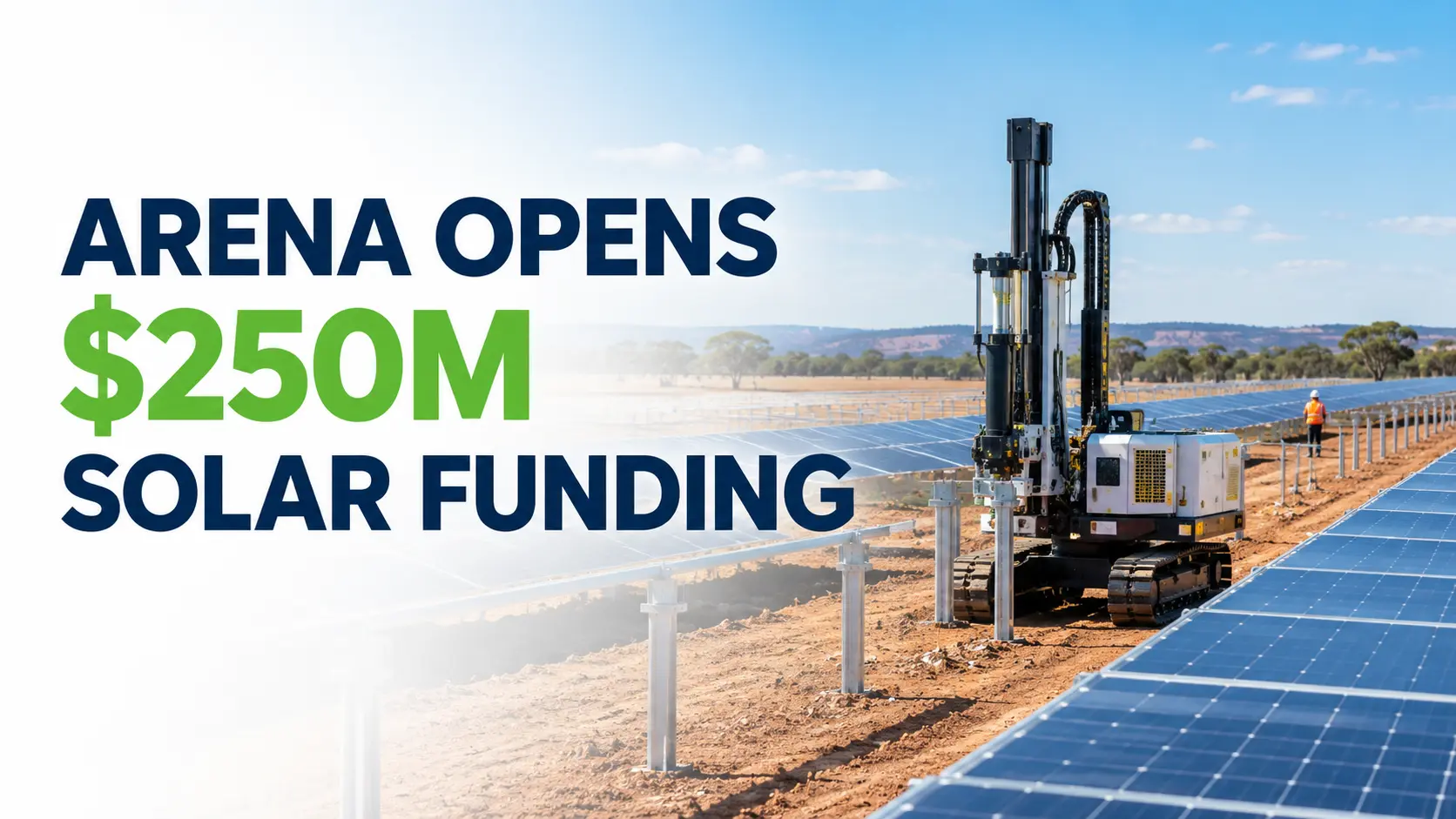
Australia is offering up to $250 million to help manufacturers produce equipment that makes large-scale solar farms cheaper and faster to build. The new funding targets the work behind the panels, from installing foundations to fitting solar modules, where labour and construction time can add to project costs.
The Australian Renewable Energy Agency (ARENA) opened the third round of its Solar Sunshot program on 15 October 2026. Companies can seek support to establish or expand manufacturing in Australia, provided their technologies meet the program’s commercial readiness requirements. ARENA’s funding announcement sets out the opportunity.
The problem is easier to see on the ground than in a funding announcement. A typical solar farm with single-axis tracking needs around 300 foundation piles per megawatt, and manual installation takes roughly 70 person-hours per megawatt, according to ARENA. When a project covers a large site, that work adds up quickly.
Can Robots Cut the Cost of Building Solar Farms?
ARENA has already backed two Australian solar robotics manufacturing projects, announced on 13 October with funding of up to $32.3 million combined.
Luminous Robotics will receive up to $17.8 million to establish a manufacturing facility in Melbourne for its LUMI robots, which install solar panels. Built Robotics Australia will receive up to $14.5 million to manufacture autonomous piling systems in Brisbane. These machines drive the steel piles that support solar farm equipment.
The projects address two jobs that require considerable time and physical effort. Built Robotics, for example, plans to manufacture 12 robotic piling systems and develop technology for pre-drilling and night operations where conditions and approvals allow. ARENA says the project aims to reduce foundation costs by up to 50% over five years and on-site piling labour by around 80%. Those are projected outcomes for that project, not savings already achieved across the solar industry.
The new $250 million round widens the search for similar cost reductions. ARENA is also inviting proposals for racking and tracking systems, advanced automation, prefabrication and other technologies that can reduce the cost of building and operating solar farms.
You may also want to read: ESYsunhome Updates HM Solar Battery Range With Higher Peak Output
What Kind of Manufacturing Will Qualify?
The funding is part of the federal government’s wider $850 million Solar Sunshot program. Earlier rounds supported solar module manufacturing and deployment innovation; Round 3 focuses on the equipment and processes used to build large-scale solar projects.
Companies must be incorporated in Australia, including eligible international businesses that establish or expand their local operations. Their proposals need a credible path to commercial-scale manufacturing. ARENA requires technologies to reach at least Technology Readiness Level 8 and Commercial Readiness Index 3 when manufacturing begins. In practical terms, the products must be well developed and close to commercial use, rather than remain at an early research stage.
That requirement matters because a local factory alone does not guarantee cheaper equipment. Manufacturers must still compete on price, quality and performance. ARENA wants projects that build lasting Australian capability, strengthen supply chains and give solar developers access to technologies that work at scale.
When Can Businesses Apply?
Expressions of interest open at 9 am AEDT on 2 November 2026. ARENA will hold an information webinar on 26 October, from 11 am to noon AEDT, for businesses that want to understand the funding opportunity.
The current deadline for expressions of interest is 12 November 2027. Full applications are due by 12 April 2028 for applicants invited to that stage. ARENA encourages businesses to discuss their proposals with the agency before applying, and the dates may change. Companies should check the official Round 3 guidelines and timetable before preparing a submission.
What Could This Mean for Your Electricity Bill?
The immediate opportunity is for manufacturers and solar developers, not households seeking a rooftop solar rebate. If the funded technologies reduce the cost of building new solar farms, developers could bring projects online more economically.
But construction costs are only one part of the price of electricity. Wholesale market prices, network charges and retail costs also affect your bill, so it would be premature to claim this funding will deliver a specific household saving.
The first thing to watch is whether the supported technologies move into commercial production and deliver measurable results on solar farms. Those results will show whether the funding reduces construction costs in practice.
Related news you may want to read: Rooftop Solar Australia Could Double to 300 Million Homes by 2030
CleanSwitch Takeaway
Australia’s $250 million Solar Sunshot round targets a practical problem: how to build large-scale solar farms with less time, labour and expense. The robotics projects already backed by ARENA show what local manufacturing could deliver, while Round 3 gives other equipment makers a chance to bring their technologies to commercial scale.
The funding creates an opportunity for Australian manufacturers, but the test will be what their products achieve on real projects. For households, any benefit is indirect and will depend on how lower construction costs affect the wider electricity market. CleanSwitch will continue following the funding decisions and keeping readers informed about developments that could affect Australia’s energy costs.