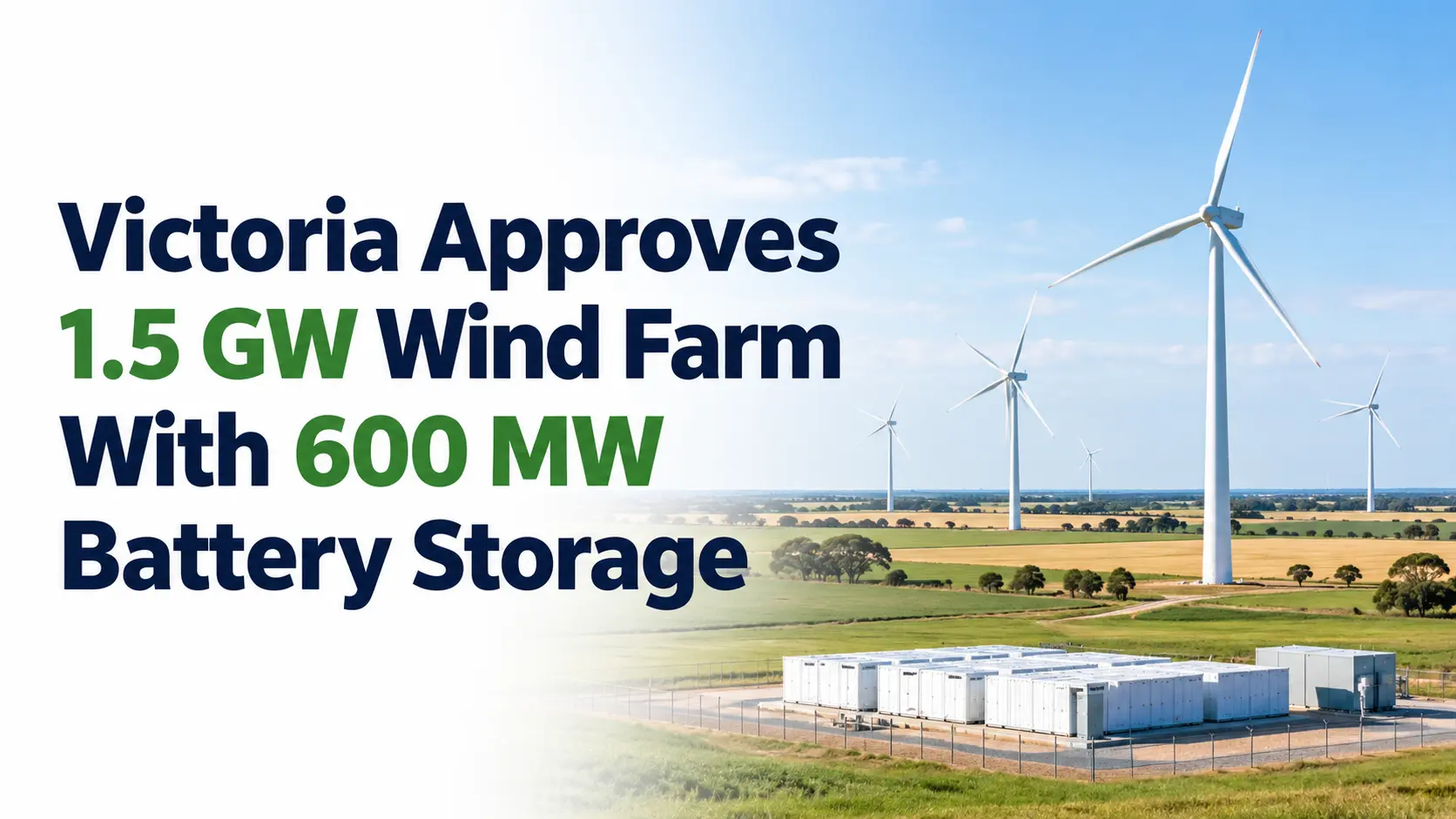

Victoria has approved a proposed 1.575-gigawatt wind farm that could supply electricity equivalent to the needs of up to 1.2 million homes. However, federal environmental approval remains outstanding, leaving another hurdle before the project can proceed.
The Warracknabeal Energy Park would feature 219 wind turbines across approximately 26,000 hectares of farmland in north-west Victoria, alongside two 300-megawatt battery energy storage systems. The development is expected to create almost 950 jobs during construction, with additional local employment once operational.
The Victorian Government announced the approval on 15 October 2026, describing the development as the largest wind farm in the Southern Hemisphere. If completed, the project would deliver around 11.8% of Victoria’s future energy needs, according to the government.
The decision clears the final state-level approval hurdle, but the project still needs to progress through the federal environmental assessment process and establish the infrastructure required to connect it to the electricity grid.
How Could the Wind Farm Affect Electricity Bills?
The Warracknabeal Energy Park could help increase electricity supply and put downward pressure on wholesale prices, although its eventual effect on household bills will depend on project costs, generation and grid conditions.
Wind farms generate electricity without purchasing fuel, allowing them to compete with generators that face ongoing fuel costs. When wind generation displaces more expensive electricity in the wholesale market, it can help reduce prices. However, wholesale electricity is only one component of household bills, which also include network charges, retail costs and other expenses.
The proposed battery systems could add flexibility by storing electricity when supply is plentiful and releasing it when demand rises. This could help manage fluctuations in renewable generation and provide electricity during periods of higher demand.
Together, the batteries would have a power rating of 600 MW. However, this figure does not reveal how long they could supply electricity because their energy storage capacity, measured in megawatt-hours, is a separate specification.
Victorian Planning Minister Sonya Kilkenny said the project would help increase supply and reduce energy costs.
“We are delivering more energy that will help lower power bills,” Kilkenny said in the government announcement.
The government also argues that the development will support Victoria’s renewable energy targets of 65% by 2030 and 95% by 2035.
However, these targets and the project’s projected contribution do not guarantee a specific reduction in electricity bills. The actual impact will depend on how the wind farm and batteries operate within the wider electricity market.
Related News: Australia’s Biggest Battery Finally Reaches Full Power After Long Delays
Federal Approval Remains a Major Hurdle
Although Victoria has completed its state approval process, the Warracknabeal Energy Park still needs federal environmental approval.
ABC News reported on 15 October that federal assessors had requested additional information from the developer. A spokesperson for the National Environmental Protection Agency said the decision had been temporarily paused while the developer supplied further information.
The outstanding federal assessment means the state approval should not be mistaken for final permission to proceed with every aspect of the project.
The proposal has already undergone Victoria’s Environment Effects Statement process, which included technical studies, community consultation and a public inquiry. The planning department published its assessment of the project’s environmental effects in May 2026, concluding that the effects could be acceptably managed subject to recommended mitigation measures.
The Victorian planning department’s project page provides further information about the assessment and proposed infrastructure.
Nearly 950 Construction Jobs Expected
The Victorian Government expects the wind farm to create almost 950 jobs during construction, followed by ongoing local employment once the facility becomes operational.
The proposed site is near Warracknabeal, more than 300 kilometres north-west of Melbourne. The development would include turbines, battery storage facilities, substations, access roads and transmission connections.
For the surrounding region, construction could generate demand for accommodation, transport, trades and other local services. However, the scale of the workforce could also put pressure on existing housing and public infrastructure.
Farmer Craig Henderson, who owns land intended to host turbines, told ABC News that the development could provide a welcome boost to Warracknabeal, a town that has experienced population decline.
He described the project as “extremely positive” for the town and said accommodation built for construction workers should leave a lasting benefit for the community.
“If accommodation is needed for the staffing to build this project, we do want to see a legacy effect, such as retirement villages and infrastructure that will be of benefit to the community for decades,” Henderson said.
His comments point to an opportunity for the project to support the region beyond its construction phase, particularly if temporary workforce accommodation can contribute to longer-term community needs.
However, Horsham Rural City Council Mayor Brian Klowss raised concerns about the impact of incoming workers on housing, roads and essential services.
“Our hospital services are suffering now … they’re basically nearly on their knees by what I’m hearing in Horsham,” Klowss told ABC News.
The concerns highlight the need for regional infrastructure to keep pace with large developments. While construction jobs could benefit local businesses, the economic gains will depend partly on how well communities manage the additional demand for services.
Transmission Lines Will Help Determine the Project’s Impact
The wind farm’s generating capacity is only part of the equation. The project also needs suitable transmission infrastructure to transport electricity from the site into the grid.
According to the Victorian planning department, the proposal includes approximately 290 kilometres of underground cabling, around 21 kilometres of overhead powerlines between sections of the project, and a further proposed connection to the Murra Warra terminal station.
These connections are important because new generating capacity cannot supply the wider electricity network without the infrastructure needed to carry its output.
Ross Johns, president of the Wimmera Mallee Environmental and Agricultural Protection Association, questioned whether the project could proceed effectively without the necessary transmission lines.
“There’s lots of evidence to suggest that this Warracknabeal Energy Park is not in the country’s and the nation’s best interests,” Johns told ABC News.
He also raised concerns about the progress of the proposed Western Renewable Link and VNI West transmission projects.
His objections reflect a wider challenge for renewable energy development: wind farms, batteries and transmission lines must progress together if new generation is to translate into additional electricity supply.
The timing and delivery of these connections will therefore be important factors in determining when the Warracknabeal Energy Park could begin supplying the grid.
You may also read: Rooftop Solar Australia Could Double to 300 Million Homes by 2030
What We Think
The Warracknabeal Energy Park could help expand Victoria’s electricity supply, but cheaper household bills will depend on the project clearing its remaining approval hurdles, connecting to the grid and delivering electricity at a competitive cost.
We will be following the federal approval process and the next developments in transmission infrastructure to see how the project progresses and whether its promised benefits eventually reach Australian households.