
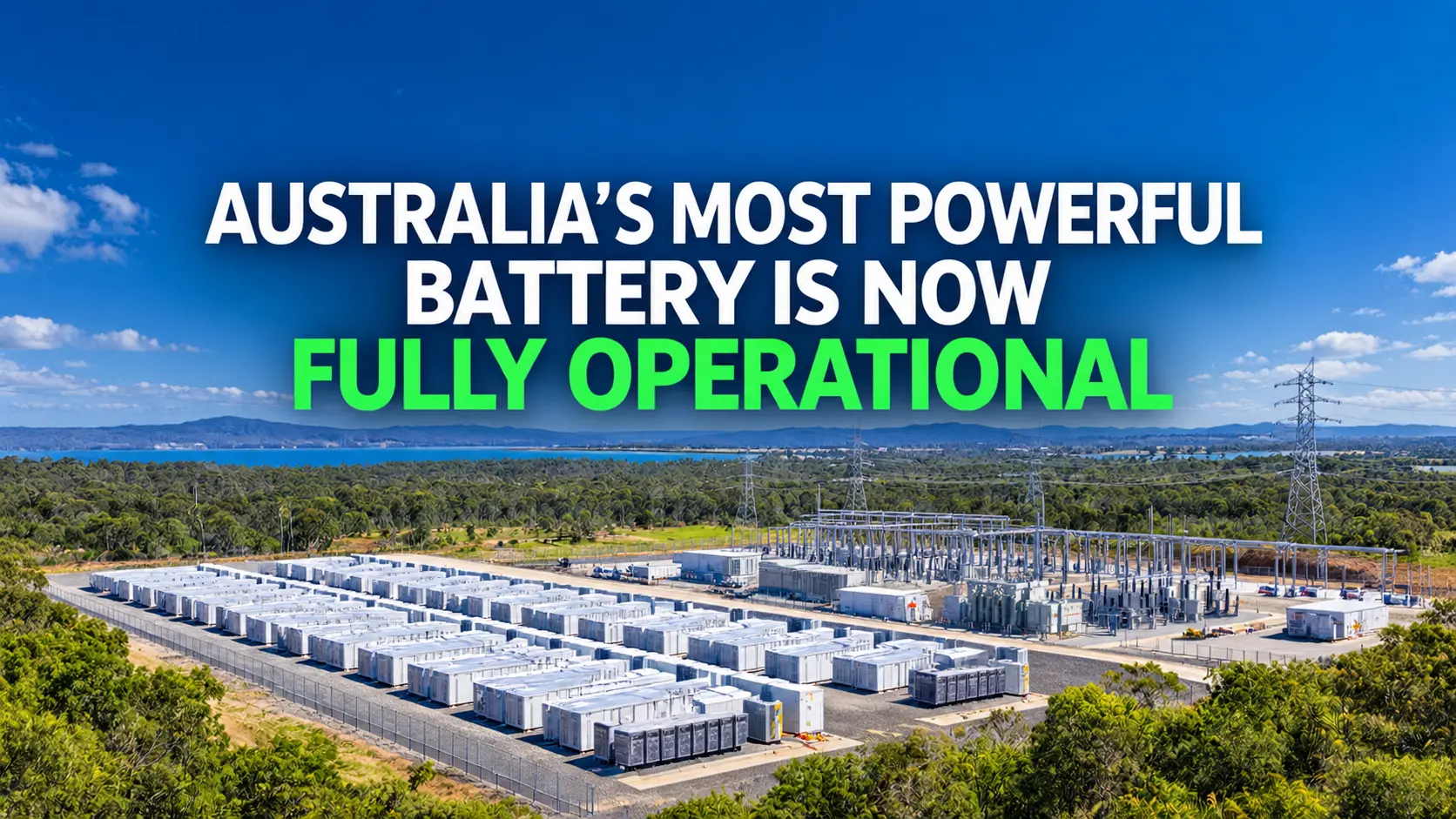
Australia’s biggest grid-connected battery has finally reached full commercial operation after lengthy construction and equipment setbacks, bringing its full 850-megawatt capacity online as NSW adjusts how the project operates and generates value for electricity consumers.
The Waratah Super Battery, built on the site of the former Munmorah coal-fired power station on the NSW Central Coast, received approval from the Australian Energy Market Operator (AEMO) to operate at full capacity in late September.
The milestone came after a transformer failure, damage to another transformer and a lengthy replacement and testing process delayed the project by around 18 months against its original schedule, according to Renew Economy’s reporting.
The battery can deliver up to 850 megawatts (MW) of power and store 1,680 megawatt hours (MWh) of energy. Its main contracted role has been to act as a giant shock absorber for the electricity grid, responding rapidly when major transmission disruptions threaten power supplies.
But the completion announcement is not the only recent development. On 8 October, the Australian Energy Regulator (AER) announced revised revenue arrangements that allow the battery to operate more dynamically in the electricity market while continuing to support energy security.
The changes also provide for trading revenue to be shared with consumers, reducing future service charges.
‘A Game Changer For NSW’: Battery Finally Reaches Full Capacity
NSW Energy Minister Penny Sharpe welcomed the completion, linking the project to the state’s changing electricity supply.
“The Waratah Super Battery is a game changer for NSW. As ageing coal-fired power stations retire, this project will help keep the lights on for homes and businesses while enabling more renewable energy to flow through the grid,” Sharpe said.
“This is exactly the kind of infrastructure NSW needs to deliver a reliable, affordable and modern energy system for generations to come.”
The project was commissioned by the NSW Government’s EnergyCo and built by Akaysha Energy. Transgrid delivered network upgrades and will oversee the battery’s operation as network operator.
The completion is significant because the battery was originally intended to help maintain grid security as the Eraring coal-fired power station approached its expected 2025 closure. Eraring’s retirement has since been delayed, with its current scheduled closure in April 2029.
Waratah’s role remains relevant as NSW works to connect more renewable generation to major demand centres around Sydney, Newcastle and Wollongong.
Why The Battery Took So Long To Complete
Waratah’s path to full operation was not straightforward.
The project experienced construction delays before a major transformer failure in October 2025 disrupted its final commissioning process. A second transformer was also damaged, and replacement equipment had to be installed and tested before the facility could receive full-capacity approval.
Renew Economy reported that the battery had been expected to be delivered around 18 months earlier than its eventual completion.
During the intervening period, the facility operated with only part of its contracted grid-protection capacity available. The final approval allows the project to move beyond that restricted operating arrangement.
The setbacks matter because the battery was designed to provide a specific service to the electricity network, not simply to store power and sell it when prices rise.
You may also read: Rooftop Solar Australia Could Double to 300 Million Homes by 2030
How Waratah Helps Protect The Electricity Grid
The Waratah Super Battery combines large-scale energy storage with a system that monitors transmission conditions and can trigger a rapid response to certain network disturbances. EnergyCo’s project overview explains how the battery, control system, paired generation services and network upgrades work together.
Transgrid CEO Brett Redman said the project provides an additional safeguard as coal-fired generation retires and new transmission infrastructure is developed.
“The delivery of the Waratah Super Battery provides an additional level of safeguard as coal plants retire and critical transmission infrastructure is built to connect more renewable energy into the Sydney, Illawarra and Hunter load centres,” Redman said.
“Our System Integrity Protection Scheme Control System is the largest and most innovative in Australia, detecting network issues in real time and responding in real time, ensuring continuity of power supply for households and businesses.”
The system is designed to respond to events such as transmission-line outages caused by bushfires, fallen trees or lightning strikes. By injecting power rapidly when required, the battery can help manage network disturbances and support the movement of electricity through existing transmission infrastructure.
That does not mean it can prevent every blackout. Its benefit depends on the type of disruption, the network conditions and the response required at the time.
The New Revenue Arrangements Could Benefit Consumers
A further development emerged on 8 October, when the AER announced that it had reviewed and remade revenue determinations for the Waratah project’s paired-generation and battery services.
The decision reflects amended contractual arrangements and allows the battery to trade electricity more dynamically while continuing to meet energy-security requirements.
The AER said revenue earned from energy trading would be shared with consumers, reducing future service charges and lowering the total cost of the battery.
This is a more specific consumer benefit than simply saying a large battery could help reduce wholesale prices. However, the regulator has not yet published a final figure showing the resulting savings for households.
The AER said it intends to publish an adjusted schedule of payments around June 2027. That schedule will include any annual revenue adjustments made before publication, including an adjustment related to the delay in the battery reaching commercial operation.
For now, the decision establishes how trading revenue can benefit consumers, but it does not support a precise dollar estimate for an individual household’s bill.
‘The Digital Brains Behind The Project’
The battery’s operation also depends on its power-conversion equipment and control technology.
According to Hitachi Energy’s project announcement, the company supplied, installed and commissioned 288 power conversion systems and two power plant controllers for the project. These components help manage the flow of electricity between the battery and the grid.
Bernard Norton, Hitachi Energy Australia’s managing director, described the project as a significant step in the development of the electricity system.
“It’s a giant digital shock absorber, bringing extra resilience and system strength to the electricity network. This is critical with large coal plants scheduled for closure, and more intermittent renewable energy entering the system,” Norton said.
The combination of storage, control technology and transmission infrastructure is what allows Waratah to serve as a grid-support asset rather than functioning only as a conventional battery that buys and sells electricity.
More news to read: Australia’s New Heat Pump Efficiency Rules: What Changes and When?
What Happens Next?
Akaysha Energy CEO Nick Carter described reaching final commercial operations as a landmark moment for the company and its project partners.
“Bringing the Waratah Super Battery to final commercial operations is a landmark moment for Akaysha Energy, our project partners and most importantly, for NSW,” Carter said.
“We are proud of what has been delivered and are now focused on the role Waratah plays in supporting a more reliable, secure and renewable NSW electricity system.”
The next test is how the battery performs in operation and how its revised commercial arrangements translate into value for consumers.
For NSW households, full operation adds a major new resource to the electricity network. The AER’s decision also creates a defined pathway for energy-trading revenue to reduce future service charges, although the size of that benefit remains to be confirmed.
Waratah’s completion therefore marks two important developments: the long-delayed arrival of its full grid-protection capability and a shift towards more flexible operation under updated revenue arrangements.