
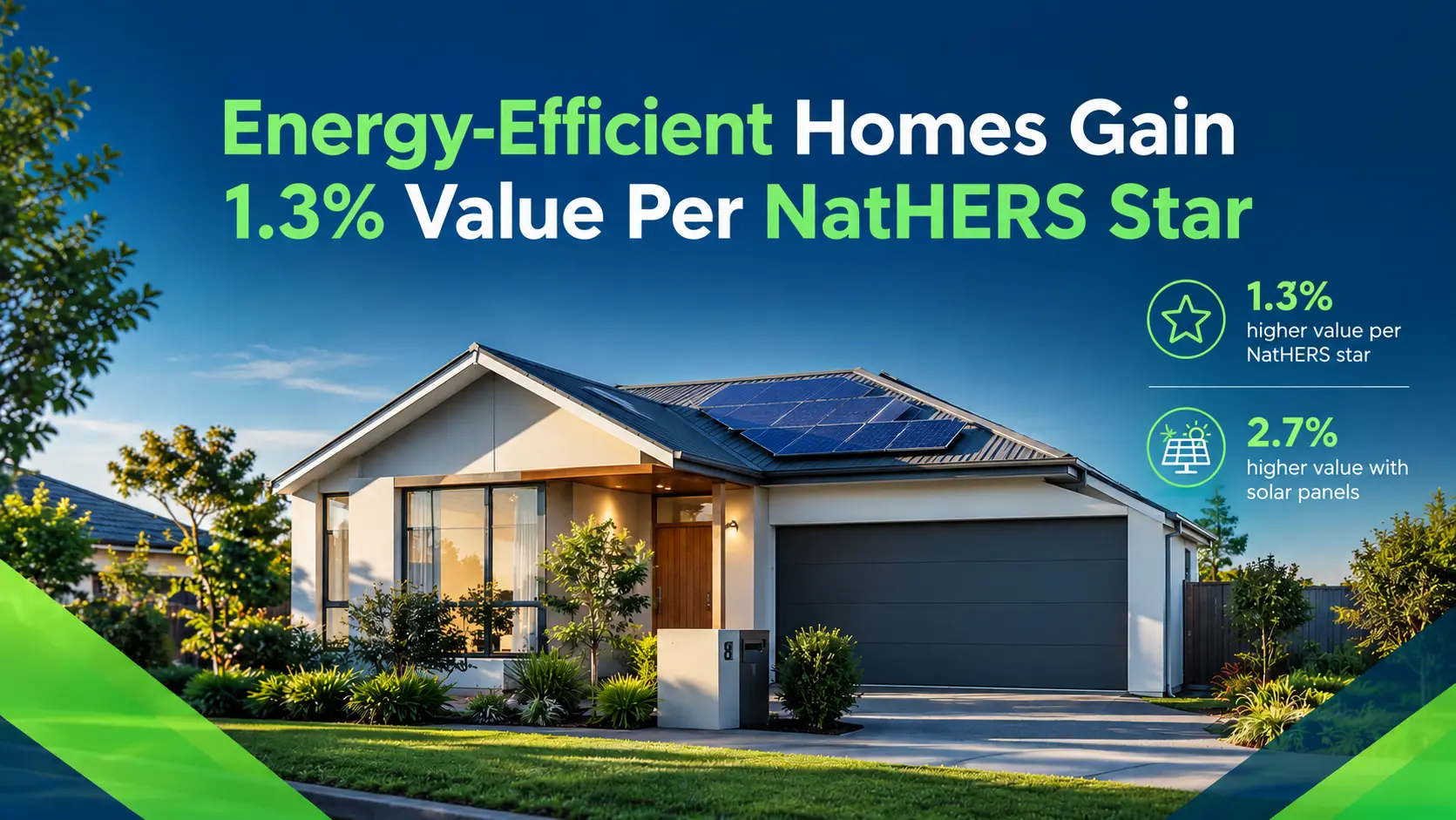

Energy-efficient homes are attracting higher values in Australia, with each additional NatHERS star associated with an estimated 1.3% increase in property value, according to new analysis of more than six million homes.
The finding comes from The Efficiency Edge, a new report from Cotality and the Real Estate Institute of Australia (REIA), which examines how energy performance is beginning to influence residential property values, buyer demand and rental returns.
Cotality’s analysis also found that homes with solar panels achieved prices around 2.7% higher than comparable properties without solar. The 1.3% NatHERS finding equates to an estimated $10,560 in additional value per star nationally, while the solar premium is equivalent to about $23,100.
The findings come as Australia moves towards greater disclosure of home energy performance, giving buyers and renters more information about how properties perform and what they may cost to run.
Energy Efficiency Is Showing Up In Property Prices
Around 70% of established Australian houses, excluding apartments, are estimated to perform below four stars out of 10 under NatHERS, according to the report, compared with the seven-star thermal-performance standard now required for new homes.
Cotality said the performance gap means many existing homes could have significantly different heating and cooling requirements despite being similar in size, age and location.
The report says improving a home from three to five stars can reduce heating and cooling energy use by around 40%.
REIA President Jacob Caine said energy performance was becoming part of the information buyers consider when assessing a property.
“Consumers are increasingly interested in understanding how a home will perform, not just what it looks like or where it’s located.”
Caine said running costs and comfort were also becoming part of property discussions.
“Comfort, running costs and energy performance are becoming part of the property conversation, and real estate professionals have an important role to play in helping consumers understand what that means in practical terms.”
The national 1.3% figure represents an association identified in Cotality’s analysis. It does not mean that adding one NatHERS star will automatically increase the sale price of every property by 1.3%.
Solar Homes Also Command A Premium
Solar was another energy feature linked to higher property values in the Cotality analysis.
Homes with solar panels achieved prices around 2.7% higher than comparable homes without solar, according to the report. The national average uplift was estimated at about $23,100.
The research does not establish that solar alone caused the difference in sale prices. Other characteristics of the homes and their locations can also affect property values.
The report’s case studies show how energy performance can feature alongside other property attributes.
A four-bedroom home in Cygnet, Tasmania, sold for $1.475 million in August 2025, around 66% above the local four-bedroom median of $890,000.
The property was designed as an energy-efficient, off-grid home. Selling agent Amber Leighton said the owners had not set out to build a property aimed only at off-grid buyers.
“They wanted to create a really beautiful, aesthetically pleasing house that happened to be off-grid and happened to have lower running costs.”
In Fremantle, Western Australia, a three-bedroom townhouse with a 7.5-star NatHERS rating sold for $1.555 million in April 2026, around 22% above the comparable townhouse median, according to the report.
Ray White Dethridge Groves sales executive Kat Goddard said the property attracted buyers from a wider range of postcodes than the agency would normally expect.
“We had buyers coming from a really wide range of postcodes that we wouldn’t normally see for a Fremantle property.”
The individual sales are case studies rather than evidence of a fixed premium for every energy-efficient property. Location, size, design, condition and wider market conditions all influence the price a home achieves.
Buyers Could Get More Information About Home Performance
The report comes as energy performance becomes more visible in Australian property transactions.
Cotality said governments are progressing the Home Energy Rating Disclosure Framework, while new tools are making performance information more accessible to property professionals and consumers.
The report also points to the growing use of estimated ratings. Cotality said it has used property data and CSIRO’s AI-based RapidRate engine to generate estimated energy ratings for millions of Australian homes.
Those estimates do not replace formal assessments, but they can provide an indication of a property’s performance before a formal rating is available.
Cotality Head of Sustainability Solutions Richard Griffiths said energy performance is becoming relevant for reasons beyond sustainability.
“For most Australians, energy performance isn’t primarily about sustainability. It’s about living in a home that is comfortable and affordable to run.”
He said buyers could increasingly expect to compare homes on performance as well as conventional property features.
“We’re used to comparing star ratings of appliances yet currently can’t do the same for our biggest lifetime purchase – our homes.”
For homeowners, that could make features such as insulation, glazing, orientation, efficient heating and cooling, solar and other energy upgrades more visible when a property goes to market.
It does not mean every upgrade will return its full cost through a higher sale price. But the new data suggests energy performance is becoming a measurable part of the Australian housing conversation.
The report also found examples of rental return increases of up to 35%, adding another potential financial consideration for landlords as energy performance becomes more visible to tenants and property managers.
Caine said the change reflects a broader shift in how Australian homes are assessed.
“Energy efficiency equals affordability, comfort and better housing. And it is firmly part of the future of real estate in Australia.”