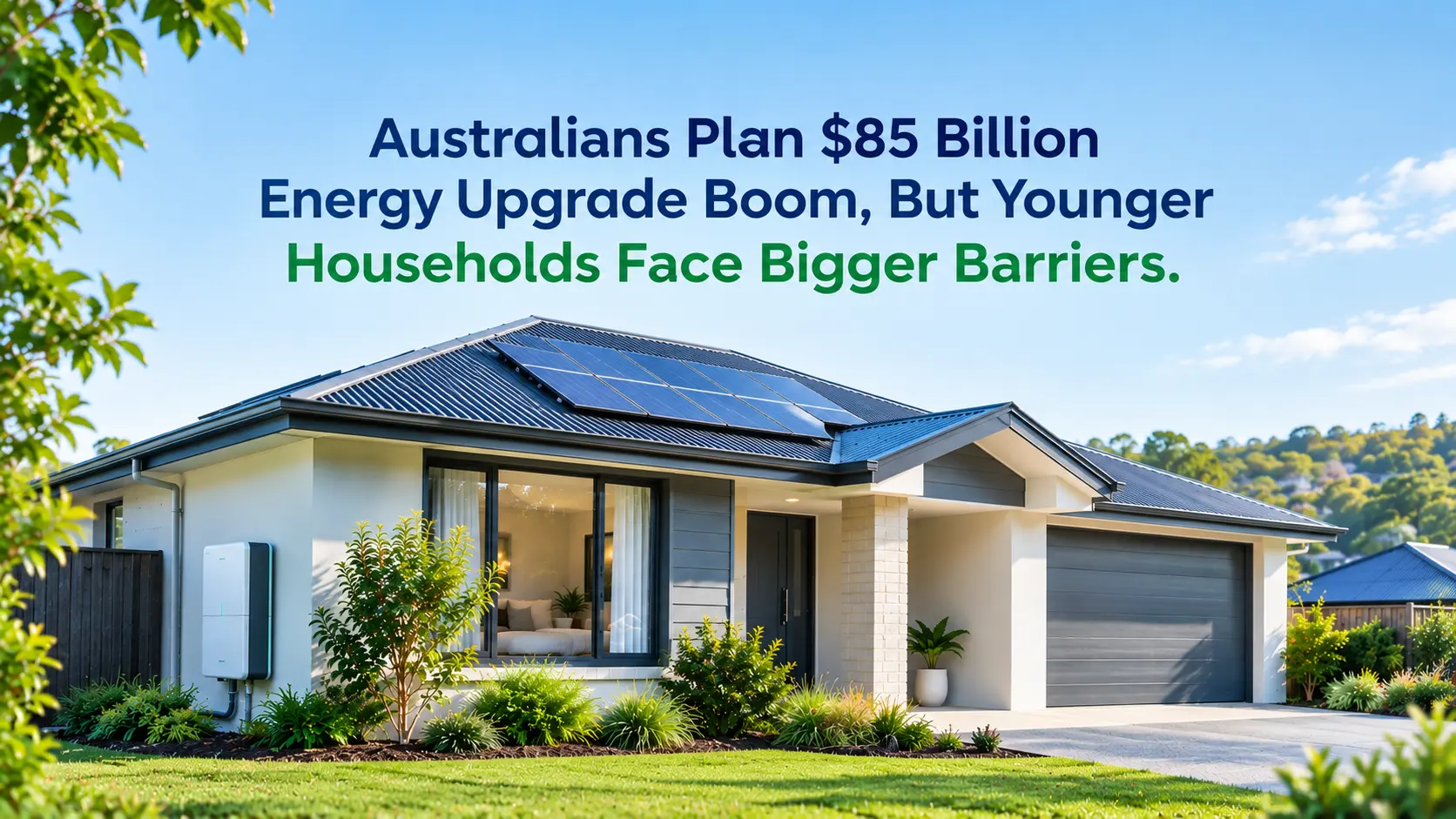
Australian households say they intend to spend more than $85 billion on home energy upgrades over the next five years, according to the 2026 PropTrack Origin Australian Home Energy Report released on September 9.
The report, based on a survey of 2,957 Australians, found that 69% plan to invest in some form of home energy improvement, up from 65% a year earlier. Average intended spending has also increased from $7,950 to $8,340 per household. If those intentions are realised, the spending could translate into more than $85 billion nationally.
That $85 billion figure is an estimate based on those spending intentions, rather than money already committed to upgrades.
Eleanor Creagh, senior economist at REA Group, stressed that distinction while discussing the findings.
“I’d stress that that’s intended spending rather than a forecast of kind of realised expenditure, but that direction is important.”
Senior Economist, REA Group
The direction is clear. More Australians are considering how much their homes cost to run, and energy efficiency is increasingly becoming part of household spending decisions.
But the potential spending boom will not look the same across Australian households.
Older Australians and homeowners are planning larger investments, while younger households and renters face lower budgets, upfront costs and less control over the properties they live in.
Energy Efficiency Is Already Mainstream
Around 80% of respondents already have at least one energy-efficient feature in their home.
The report found that households are adopting measures such as insulation, efficient lighting and solar, while battery ownership is also increasing.
Those planned upgrades come on top of a sizeable base of existing energy-efficient homes.
The next five years could bring a much larger wave of investment if households follow through on those plans.
Australians are increasingly considering larger investments involving solar, batteries, electrification, appliances, insulation and other technologies that can change how a home produces and uses energy.
For Origin Energy, those decisions are also becoming more common in conversations with customers.
Catherine Anderson, Chief Marketing Officer at Origin Energy, said customers are increasingly asking how new technologies will affect their household energy costs.
“They’re even getting an EV, and then they’re calling us to say, ‘Well, how am I going to charge this and not impact my bill?’”
She said customers are also asking what the financial payoff could be from installing solar and batteries.
The shift is therefore about more than individual products. Households are increasingly considering how different technologies could work together.
Older Australians Plan To Spend More
The national average hides a significant difference between age groups.
Australians aged 50 to 64 intend to spend about $9,450 on energy upgrades over the next five years.
For those under 35, the figure is about $5,900.
That is a difference of more than $3,500.
The gap does not necessarily suggest younger Australians are less interested in efficient homes. It reflects the financial and housing circumstances they face.
Younger households are more likely to face housing affordability pressures, while renters have less control over the properties in which they live.
That creates an important divide between wanting to make an upgrade and having the ability to make one.
Renters Face A Different Barrier
A homeowner can decide to install solar panels, improve insulation or replace inefficient equipment.
A renter usually cannot make those decisions alone.
The report identifies lack of control over the property as a barrier, with the issue particularly relevant to younger Australians. It also shows that homeowners spent considerably more on energy-efficiency improvements than renters.
That creates a difficult situation.
Renters still pay their energy bills. They still live with poor insulation, inefficient appliances or homes that are difficult to heat and cool.
But the person who pays for the energy is often not the person who controls the property.
The result is that Australia’s home energy transition is also becoming a housing issue.
Upfront Cost Could Stop Intentions Becoming Investment
The biggest question surrounding the $85 billion estimate is how much of that intended spending will actually happen.
Forty-three per cent of respondents identified upfront cost as the biggest barrier to energy-efficiency improvements. The report also found that around two in five Australians do not know how to improve the energy efficiency of their homes.
That combination matters.
A household can understand that an upgrade could reduce future running costs and still decide that the initial expense is too high.
The knowledge gap creates another hurdle. Australians may know they want a more efficient home without knowing which improvement should come first or how different technologies work together.
Creagh said the research shows a connection between knowledge and action.
People with a stronger understanding of energy efficiency and electrification were more likely to have already invested in improvements and to have higher budgets for future upgrades.
That suggests the $85 billion estimate will depend on more than household interest.
It will also depend on whether Australians have the money, information and control needed to act.
The Push Towards All-Electric Homes Is Growing
Energy upgrades are also becoming part of a broader move towards electrification.
The report found that 39% of Australians would consider switching to an all-electric home.
For households already considering solar, batteries and electric vehicles, the decision is increasingly about how those technologies fit together.
An electric vehicle raises questions about charging. A battery raises questions about solar generation and household demand. Efficient appliances and insulation can change how much energy a home needs in the first place.
That is creating a more connected way of thinking about household energy.
The $85 Billion Question Is Who Gets To Participate
The potential scale of Australia’s next home energy upgrade cycle is significant if households follow through on their plans.
Nearly seven in 10 Australians say they intend to invest in improvements over the next five years, while four in five already have at least one energy-efficient feature in their homes.
But the planned spending is not evenly distributed.
Older households are planning larger investments. Younger households have lower intended budgets. Renters have less control over their homes. And upfront costs remain the biggest barrier for many Australians.
That makes the $85 billion estimate more than a measure of household intentions.
It also raises a bigger question about Australia’s energy transition: if more households want efficient, electrified homes, will everyone have a realistic chance to create one?