
A Quick Overview
The NSW Home Energy Saver Loan gives owner-occupiers and landlords earning under $210,000 a 0% interest, fee-free loan of up to $15,000 for energy upgrades like solar, batteries, EV Level 2 chargers, insulation, and heat pumps.
The loan is awarded after any eligible rebates are deducted first from the upgrade costs, leaving you to finance only the remaining balance over up to 10 years via approved providers Brighte or Plenti. You just need to meet requirements and get a quote from an accredited NETCC installer to start.
What Is the NSW Home Energy Saver Loan?
The NSW Home Energy Saver Loan is a government-backed, interest-free finance program designed to remove the cost barriers that deter people from improving home energy efficiency.
It’s meant for NSW residents who want to install solar panels, replace ageing hot water systems, improve insulation, or switch to efficient electric appliances but can’t afford the full upgrade costs out of pocket.
Rather than delaying these improvements, the NSW Government lends up to $15,000 to cover upgrade costs and allows borrowers to spread repayments over up to 10 years.
The loan forms part of the broader Home Energy Saver Program, launched in June 2026 with $557 million in funding. Of this, approximately $480 million has been allocated to zero-interest loans, while the remaining funding supports targeted discounts for lower-income households. The Government expects the loan program alone to assist more than 32,000 NSW households in making energy-saving upgrades.
Unlike a traditional personal loan, borrowers pay:
- 0% interest
- No book keeping fee over the life of the loan
- Over up to 10 years
- Only the amount actually borrowed
Why Was the Home Energy Saver Loan Program Introduced?
The NSW Government introduced the Home Energy Saver Loan to make energy-efficient home upgrades more affordable.
The government understands that many households want to install energy-saving technologies such as solar panels, home batteries, or heat pump hot water systems, but the upfront costs make these upgrades difficult to afford.
The loan removes that financial barrier by offering interest-free finance, allowing eligible households to spread the cost over up to 10 years instead of paying thousands of dollars upfront. This helps more households reduce their energy bills while supporting NSW’s transition to cleaner, more efficient homes.
Is It a Loan or a Rebate?
The Home Energy Saver Loan is not a rebate.
A loan allows you to spread the remaining cost over time, but the borrowed amount must eventually be repaid.
A rebate or discount permanently reduces the purchase price and never needs to be repaid. The broader NSW scheme includes a targeted $4,000 discount opening late 2026 for concession cardholders or lower-income earners (under $80,000 combined income).
Who Is the Home Energy Saver Loan Meant to Benefit?
The program targets households that may struggle with large upfront installation costs but can comfortably repay an interest-free loan over time.
Eligible home energy efficient upgrade loan applicants include:
- Owner-occupiers
- Residential landlords
- Australian citizens and permanent residents
- Households meeting the income requirements
- NSW residential properties that satisfy program rules
Key Facts at a Glance
| Feature | Details |
| Loan type | NSW Government-funded interest-free loan |
| Maximum loan | Up to $15,000 |
| Interest rate | 0% fixed |
| Repayment period | Up to 10 years (120 months) |
| Finance providers | Brighte and Plenti |
| Eligible applicants | Owner-occupiers and landlords |
| Household income | Up to $210,000 combined annual taxable income |
| Program funding | $557 million total allocation |
| Expected households supported | More than 32,000 residential properties |
How Does the NSW Home Energy Saver Loan Work?
The Home Energy Saver Loan follows a straightforward process designed to minimise the amount you need to finance.
Instead of borrowing the full installation cost, any eligible rebates and discounts are applied first. You then borrow only the remaining balance, making repayments more manageable.
The basic process works like this.
1. Choose Approved Energy Upgrades
First, decide which eligible improvements you want to install.
Depending on your home’s needs, this could include solar panels, a home battery, a heat pump hot water system, insulation, reverse-cycle air conditioning, or multiple upgrades completed together.
Bundling several improvements into one project can often improve overall energy efficiency while reducing installation costs.
2. Obtain Quotes From Approved Installers
You’ll need quotations from participating installers who offer products approved under the Home Energy Saver Program.
The installer will explain which upgrades qualify, provide pricing, and identify any rebates that can reduce your upfront cost.
3. Rebates and Discounts Are Applied First
One of the biggest advantages of the scheme is that government incentives reduce your purchase price before the loan is calculated.
For example, depending on your project, you may qualify for:
- Federal Small-scale Technology Certificates (STCs) for solar
- NSW Energy Savings Scheme incentives
- Battery incentives (where applicable)
- Home Energy Saver discounts (for eligible lower-income households)
These incentives lower the amount requiring finance.
4. Borrow Only the Remaining Balance
The loan amount is calculated using a simple formula:
Amount Borrowed = Total Upgrade Cost − Eligible Rebates and Discounts
For example:
| Example | Amount |
| Total installation cost | $16,000 |
| Rebates and discounts | -$5,500 |
| Amount financed | $10,500 |
Instead of financing the entire project, you’re only repaying the remaining balance.
5. Loan Approval Through an Approved Finance Provider
The NSW Government funds the program, but loans are administered through approved finance providers:
Like any finance application, you’ll undergo a credit assessment before approval.
6. Your Installer Completes the Work
Once finance has been approved, your chosen installer completes the installation according to program requirements.
Following installation, the finance provider pays the installer directly.
7. Repay the Loan Over Time
Rather than paying thousands of dollars upfront, you repay the interest-free loan over an agreed repayment term of up to 10 years.
Because there is no interest, every repayment goes directly towards reducing the amount borrowed.
For many households, the lower electricity bills generated by efficient appliances help offset a significant portion of the loan repayments over time. While actual savings depend on the property and energy use, NSW Government modelling suggests that a household completing around $15,000 in eligible upgrades could reduce annual energy costs by up to $2,000.
Who Can Apply for the Home Energy Saver Loan in NSW?
The NSW Home Energy Saver Loan is available to a broad range of residential property owners, but not every household will qualify automatically. In addition to meeting the program rules, applicants must also satisfy the lending criteria of the approved finance provider.
The loan is designed to support households that are investing in energy-efficient improvements to residential properties across New South Wales.
Owner-Occupiers
If you own and live in your home, you may be eligible to apply, provided you meet the program’s income requirements and pass the finance provider’s credit assessment.
The property must be located in NSW, and the upgrades must be installed by a participating installer using eligible products.
Landlords
Landlords are also eligible to apply for the Home Energy Saver Loan.
This allows owners of residential investment properties to improve energy efficiency without paying the full installation cost upfront. It helps them install upgrades such as solar panels, efficient hot water systems, or insulation that can make rental properties more attractive to tenants while reducing household energy consumption.
Residential Properties
The loan applies to eligible residential properties in NSW, including:
- Owner-occupied homes
- Investment properties
- Existing residential dwellings
Commercial buildings and non-residential properties are not covered under the scheme.
Household Income Requirements
To qualify, the combined taxable income of the household must generally be $210,000 or less per year.
For households earning above this threshold, the Home Energy Saver Loan is generally not available. However, other rebates or incentives may still apply depending on the type of upgrade being installed.
The income cap is intended to direct interest-free finance towards households that are more likely to face affordability barriers when upgrading their homes.
Other Eligibility Conditions For Home Energy Saver Loan
Applicants should also be aware of several additional requirements:
- The property must be located in NSW.
- The upgrade must be an approved technology under the program.
- Installation must be completed by a participating installer.
- Finance is subject to the lender’s credit assessment and approval.
- Eligible rebates and discounts must be applied before the loan amount is calculated.
Pro Tip: Meeting the program eligibility requirements does not guarantee loan approval, as approved finance providers will also assess your ability to repay the loan.
What Upgrades Can You Finance Under the NSW Home Energy Saver Loan?
One of the biggest advantages of the Home Energy Saver Loan is the wide range of eligible upgrades. Rather than focusing on a single technology, the program supports improvements that reduce household energy consumption, improve comfort, and accelerate home electrification.
Many households choose to combine several upgrades into one project, helping maximise energy savings while financing only the remaining balance after rebates.
Solar and Battery Upgrades
Solar energy remains one of the most popular investments for NSW homeowners because it can significantly reduce daytime electricity costs.
Eligible upgrades include:
- Rooftop solar panel systems
- Home battery storage systems
- Switchboard upgrades required for installation
A battery can store excess solar electricity generated during the day, allowing households to use more of their own energy during the evening instead of purchasing electricity from the grid.
Where eligible, federal solar incentives and battery discounts are applied before calculating the loan amount.
Hot Water Upgrades
Water heating is one of the largest energy users in many Australian homes, accounting for around 15–30% of household energy consumption, according to the Australian Government.
The Home Energy Saver Loan can finance:
- Heat pump hot water systems
- Solar hot water systems
Replacing an ageing electric resistance hot water system with a modern heat pump can dramatically reduce electricity use because heat pumps move heat rather than generate it directly.
Heating and Cooling
Heating and cooling can account for up to 40% of residential energy use, making efficient appliances one of the quickest ways to reduce electricity consumption.
Eligible upgrades include:
- Reverse-cycle air conditioners
- DC ceiling fans
Modern reverse-cycle systems provide both heating and cooling while consuming significantly less electricity than older electric heaters or portable cooling units.
Home Energy Efficiency
Improving the building itself often delivers long-term savings by reducing the amount of heating and cooling required throughout the year.
Eligible improvements include:
- Ceiling insulation
- Draught proofing
- Double glazing
These upgrades help maintain a more stable indoor temperature, making the home more comfortable while lowering ongoing energy costs.
Home Electrification
The Home Energy Saver Loan also supports households transitioning away from gas by financing electric alternatives.
Eligible upgrades include:
- Electric vehicle (EV) chargers
- Induction cooktops
Installing an EV charger allows homeowners to conveniently charge their vehicle at home, while induction cooking offers faster heating, improved efficiency, and better indoor air quality than traditional gas cooktops.
Energy Assessments
Before investing in multiple upgrades, some households choose to understand where their home is losing energy.
The 0% interest loan can also cover:
- NatHERS home energy assessments
These assessments evaluate a home’s thermal performance and can help identify which improvements are likely to deliver the greatest reduction in energy use.
By combining an assessment with targeted upgrades, homeowners can make more informed investment decisions rather than replacing appliances individually.
How Much Can You Borrow Through the NSW Home Energy Saver Loan?
Eligible households can borrow interest free loans up to $15,000 per residential property through the NSW Home Energy Saver Loan and repay in 120 months.
The amount approved will depend on:
- The total cost of eligible upgrades.
- Any rebates or discounts applied.
- The finance provider’s lending assessment.
- The amount you choose to finance.
Because rebates are deducted first, many households borrow considerably less than the total installation cost.
Typical Borrowing Examples
Here are a few examples of how the loan works in practice.
| Upgrade | Total Cost | Rebates & Discounts | Amount Financed |
| Heat pump hot water | $4,800 | $1,500 | $3,300 |
| Solar panels | $10,500 | $3,800 | $6,700 |
| Solar + battery | $18,000 | $5,500 | $12,500 |
| Multiple home efficiency upgrades | $14,200 | $2,700 | $11,500 |
Actual costs and incentives will vary depending on the installer, product selection, system size, and property.
How Rebates Affect Home Energy Saver Loan Borrowing
A common misconception is that the loan finances the entire project.
Instead, rebates reduce the purchase price before finance is calculated.
The formula is straightforward:
Amount Financed = Total Installation Cost − Eligible Rebates and Discounts
For example:
- Total project cost: $15,000
- Government rebates: $4,000
- Amount borrowed: $11,000
This approach ensures households only repay the portion of the project that remains after all available incentives have been applied.
How Do You Apply for the Home Energy Saver Loan?
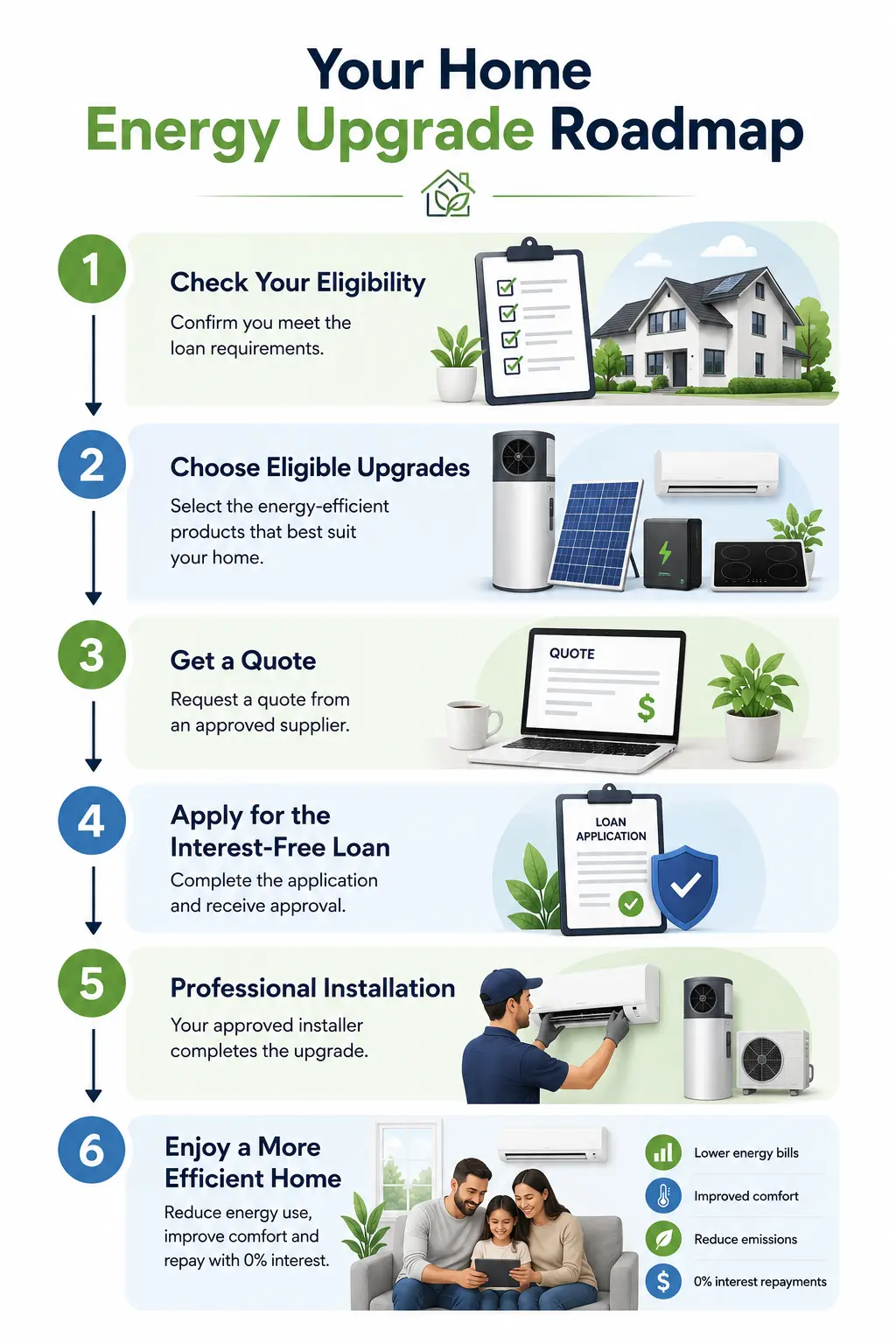
Applying for the loan is straightforward and usually follows these seven steps.
1. Check Your Eligibility
Confirm your residential property location, ensure your household taxable income does not exceed $210,000, and check that your planned upgrades are on the state’s approved technology roster.
2. Choose an Approved Finance Provider
Select either Brighte or Plenti as your delivery partner. Visit their portals to review specific credit assessment conditions
3. Obtain Quotes From Approved Installers
Choose eligible products and obtain quotes from participating installers, who can also identify any rebates you’re entitled to receive.
4. Apply Available Rebates
Your installer applies all eligible rebates and discounts first, reducing the amount you’ll need to borrow.
5. Submit Your Loan Application
The finance provider assesses your application, including a standard credit check, before approving the interest-free loan.
6. Complete the Installation
Once approved, the installer completes the work, and the finance provider pays the financed amount directly to the installer.
7. Begin Repayments
You start repaying the interest-free loan over the agreed term of up to 10 years. Make sure you clear your loan within this duration to avoid possible penalties from the lenders.
How Do You Repay the NSW Home Energy Saver Loan?
The Home Energy Saver Loan is designed to keep repayments manageable by spreading them over an extended period without charging interest.
Loan Terms of Up to 10 Years
Depending on the amount borrowed and the finance agreement, eligible borrowers can choose a repayment term of up to 10 years.
Longer loan terms generally reduce each repayment, although the overall amount repaid remains the same because the loan carries 0% interest.
Interest-Free Repayments
Unlike a traditional personal loan, you do not pay interest on the amount borrowed.
If you finance $10,000, you repay $10,000—not $10,000 plus years of interest charges. Every repayment goes directly towards reducing the loan balance.
Flexible Repayment Options
Approved finance providers may offer different repayment schedules, including:
- Weekly
- Fortnightly
- Monthly
The available options will depend on your finance agreement and the lender’s terms.
You Repay Only What You Borrow
Because rebates and discounts reduce the project cost before finance is arranged, you’re never repaying money that has already been covered by government incentives.
For example:
- Installation cost: $13,500
- Rebates applied: $3,500
- Loan amount: $10,000
Your repayments are based only on the $10,000 financed.
Can You Make Early Repayments?
Yes. Approved finance providers generally allow borrowers to make additional repayments or pay out the loan early without interest charges. However, it’s worth checking your finance agreement for any administrative fees or specific conditions that may apply.
Can You Combine Rebates With the Home Energy Saver Loan?
Yes. One of the biggest advantages of the NSW Home Energy Saver Loan is that it can be stacked with eligible government rebates and incentives. Any rebates you’re entitled to are applied before the loan amount is calculated, so you only finance the remaining balance.
Federal STC Solar Rebate
If you’re installing rooftop solar, you’ll generally receive the Australian Government’s Small-scale Technology Certificates (STCs) as an upfront discount. For many NSW households, this reduces the cost of a typical 6.6 kW solar system by around $2,000 to $3,000, depending on system size, location, and current STC values.
Federal Battery Rebate
Eligible battery installations can also access the Australian Government’s Cheaper Home Batteries Program, which provides an upfront discount of around 30% on the battery cost. For example, a 13.5 kWh battery costing around $15,000 could receive a rebate of approximately $4,500, significantly reducing the amount you need to finance.
NSW Energy Savings Scheme (ESS)
Many eligible upgrades, including heat pump hot water systems, reverse-cycle air conditioners and insulation, may also qualify for discounts under the NSW Energy Savings Scheme (ESS). Depending on the upgrade, these incentives can reduce installation costs by hundreds or even thousands of dollars.
Example
If your total upgrade costs $18,000 and you receive:
- STC solar rebate: $2,500
- Federal battery rebate: $4,500
- ESS incentive: $1,000
Your loan would only need to finance $10,000.
Formula:
Amount Borrowed = Total Upgrade Cost − Eligible Rebates and Discounts
What Are the Benefits of the NSW Home Energy Saver Loan?
No Interest Charges
Unlike most personal or green loans, the Home Energy Saver Loan charges 0% interest and no account-keeping fees. That means you repay only the amount you borrow, making eligible upgrades more affordable over the life of the loan.
Lowers Upfront Costs
Large upgrades like solar panels, batteries, and heat pump hot water systems can cost thousands of dollars. The Home Energy Saver Loan removes much of that upfront burden by letting you spread the remaining cost over up to 10 years after eligible rebates have been applied.
Saves on Energy Bills
Energy-efficient upgrades can significantly reduce household electricity use. The NSW Government estimates that households completing around $15,000 in eligible upgrades could save up to $2,000 a year on energy bills, depending on the upgrades installed and their energy usage.
Helps to Replace Old Appliances Sooner
Many households delay replacing ageing hot water systems or inefficient heating and cooling because of the upfront cost. Interest-free finance makes it easier to upgrade sooner, helping reduce running costs while avoiding unexpected breakdowns.
Improve Home Comfort
Upgrades such as ceiling insulation, draught proofing, and double glazing help keep homes cooler in summer and warmer in winter. They also reduce the workload on heating and cooling systems, making your home more comfortable year-round.
Support Home Electrification
The loan supports the switch from gas to efficient electric technologies, including heat pump hot water systems, induction cooktops, and EV chargers. Combined with rooftop solar, these upgrades can reduce reliance on grid electricity and help lower household emissions.
Is the NSW Home Energy Saver Loan Worth It?
For many eligible households, yes.
The loan is particularly worthwhile if you’re planning several upgrades but don’t want to pay the full cost upfront. Because it charges 0% interest and works alongside existing rebates, it reduces both your immediate costs and the amount you need to finance.
For example, a homeowner installing solar panels, a battery, and a heat pump hot water system could reduce the project cost through government rebates before financing the remaining balance over up to 10 years.
However, if you already have sufficient savings to pay upfront or you’re only undertaking a small upgrade, you may decide that financing isn’t necessary.
Bottom line: If you’re looking to improve your home’s energy efficiency without taking out a traditional interest-bearing loan, the NSW Home Energy Saver Loan is one of the most affordable financing options currently available.
Frequently Asked Questions About Home Energy Saver Loan
How is the Home Energy Saver Loan different from other green energy loans?
Unlike most green loans offered by banks, the NSW Home Energy Saver Loan charges 0% interest and no account-keeping fees. It’s also backed by the NSW Government and designed specifically for approved home energy upgrades.
Another key difference is that eligible government rebates and discounts are applied before the loan amount is calculated, so you only finance the remaining cost rather than the full installation price.
Can I get the Home Energy Saver Loan if I don’t qualify for rebates?
Yes. While rebates reduce the amount you need to borrow, you may still be eligible for the interest-free loan if you meet the program requirements and your chosen upgrade qualifies.
Can I borrow the full $15,000 loand and discount?
No. You only need to borrow the amount required after eligible rebates and discounts have been applied. You can finance a smaller amount if your upgrade costs less than the maximum loan limit.
Can I sell my property while I have the Home Energy Saver Loan?
Yes. Selling your property doesn’t automatically affect your ability to sell. However, the loan remains your responsibility, so you should contact your finance provider before settlement to understand your repayment options.
What happens to my Home Energy Saver Loan if I sell my property?
The Home Energy Saver Loan does not automatically transfer to the new owner. In most cases, the remaining loan balance must be repaid or settled according to the terms of your finance agreement, often as part of the property settlement process. Because loan conditions may vary between finance providers, always check your agreement or speak with your lender before selling your property.
What happens if my upgrades cost more than $15,000?
The Home Energy Saver Loan can finance up to $15,000 per eligible property. If your project costs more than this after rebates have been applied, you’ll usually need to pay the remaining balance yourself or arrange additional finance.
Can I combine multiple upgrades under one Home Energy Saver Loan?
Yes. You can combine eligible upgrades such as solar panels, home batteries, heat pump hot water systems, reverse cycle air conditioners, insulation, and EV chargers, provided the total financed amount stays within the loan limit.